Complete Horse Tack Guide for Riders, Schools & Equestrian Brands
Horse tack is the working connection between horse and rider. It is not just equipment placed on a horse before riding. Every saddle, bridle, bit, rein, girth, pad, rug, blanket, boot, and accessory affects comfort, communication, safety, movement, and long-term performance. When tack fits well and is made from suitable materials, the horse can move more freely and the rider can give clearer aids. When tack is badly fitted, poorly made, or neglected, problems appear quickly.
This complete horse tack guide is written for riders, riding schools, equestrian retailers, wholesalers, distributors, and private label brands that need a clear understanding of tack before buying, sourcing, or manufacturing. It explains what horse tack includes, how each item works, what materials matter, how fit affects welfare, and how businesses should plan tack quality at scale.
For GHC Sportswear®, horse tack is not viewed as a random accessory category. It sits inside a wider equestrian manufacturing system that includes riding apparel, horse gear, branded products, and bulk supply support. Buyers who want to understand the wider company can start from the GHC Sportswear® homepage.
Complete Horse Tack Guide: What Horse Tack Includes
Horse tack covers the equipment used to ride, handle, train, protect, or manage horses. Some pieces are used every day, while others are discipline-specific or seasonal. A complete tack setup may include saddles, bridles, bits, reins, girths, stirrup leathers, stirrups, saddle pads, martingales, breastplates, halters, lead ropes, horse rugs, blankets, fly masks, boots, wraps, and lunging equipment.
Each product has a job. The saddle supports the rider and distributes weight. The bridle supports communication. The bit helps transmit rein aids. The girth stabilizes the saddle. The pad protects the horse’s back and helps manage sweat. Rugs and blankets protect the horse from weather, cold, insects, or stable conditions. None of these items should be treated as decoration only.
A common mistake is buying tack because it looks good in photos. Appearance matters for retail, branding, and presentation, but function comes first. Tack must be comfortable, adjustable, durable, and suitable for the horse, rider, and use case.
Why Horse Tack Fit Matters
Fit is the foundation of tack performance. A saddle that pinches, a bridle that pulls, or a girth that rubs can create discomfort and resistance. The British Horse Society explains in its tack fit guidance that badly fitted tack can interfere with comfort, balance, and welfare.
A horse cannot explain discomfort with words, so it shows it through behavior. Riders may notice stiffness, head tossing, reluctance to move forward, ear pinning, bucking, biting during tacking, tail swishing, or sudden changes in performance. These signs are often blamed on attitude or training, but tack fit should always be checked early.
For riding schools and equestrian businesses, fit matters even more because the same tack may be used by different riders across multiple horses. Equipment must be checked regularly, recorded properly, and replaced before it becomes unsafe.
Main Horse Tack Items and Their Role
| Tack Item | Main Function | What Can Go Wrong | What Buyers Should Check |
|---|---|---|---|
| Saddle | Supports rider and distributes weight | Pressure points, slipping, imbalance | Tree shape, panel contact, stitching, padding |
| Bridle | Holds bit and supports communication | Tight browband, wrong noseband, poor adjustment | Size range, leather quality, pressure points |
| Bit | Transmits rein aids | Wrong size, harsh mouthpiece, poor position | Mouth fit, horse response, smooth finish |
| Girth | Secures saddle | Tightness, rubbing, slipping | Elastic quality, buckle strength, shape |
| Saddle Pad | Cushions and absorbs sweat | Too thick, poor shape, reduced stability | Breathability, contour, washing performance |
| Reins | Rider communication | Poor grip, weak stitching | Grip texture, length, buckle quality |
| Breastplate | Helps saddle stability | Used to hide poor saddle fit | Adjustability and safe attachment points |
| Horse Rug | Protects horse from weather or cold | Poor fit, rubbing, weak straps | Fabric strength, closures, sizing |
This table shows why tack should be evaluated as a complete setup. One weak component can affect the full riding system.
Saddles: The Most Important Tack Investment
The saddle is usually the most important tack item because it sits between the rider and the horse’s back. A good saddle helps distribute weight evenly, supports rider balance, and allows the horse’s shoulders and back to move. A bad saddle can make even a well-trained horse uncomfortable.
World Horse Welfare explains in its saddle fitting, use, and maintenance guidance that a poorly fitting or poorly maintained saddle can cause injury and welfare problems. This makes saddle choice, inspection, and maintenance essential.
A good saddle should sit level, avoid pinching the withers, allow shoulder movement, distribute pressure evenly, remain stable during riding, support the rider’s position, and match the horse’s current body condition.
Saddle fit can change over time. A horse may gain muscle, lose weight, change workload, age, or recover from injury. A saddle that fit well last year may not fit today. This is why regular saddle checks matter.
For B2B buyers, saddle quality is also a commercial decision. Riding schools need saddles that can handle daily use. Retailers need consistent sizing and finish. Equestrian brands need products that can be reordered with the same quality and shape. Wholesalers need saddles that can survive shipping, storage, handling, and customer inspection.
English Saddles vs Western Saddles
English and Western saddles are built for different riding styles. English saddles are usually lighter and designed for closer contact. They are common in dressage, jumping, eventing, and general English riding. Western saddles are usually heavier, deeper, and designed for stability during long rides, ranch work, and trail riding.
| Saddle Type | Common Use | Main Strength | Main Consideration |
|---|---|---|---|
| English Saddle | Jumping, dressage, eventing | Close contact and rider mobility | Requires precise fit |
| Western Saddle | Trail, ranch, rodeo | Stability and weight distribution | Heavier and bulkier |
| General Purpose Saddle | Mixed riding | Versatile for beginners | May not specialize deeply |
| Endurance Saddle | Long-distance riding | Comfort over long hours | Needs strong material and fit |
| Dressage Saddle | Flatwork and precision | Deep seat and leg position | Fit must support posture |
There is no single best saddle for every rider. The right choice depends on discipline, horse shape, rider experience, and intended use.
Bridles: Fit, Comfort, and Communication
A bridle must hold the bit correctly without creating unnecessary pressure. Many riders focus heavily on saddles but overlook bridle fit. That is a mistake. A poorly fitted bridle can create discomfort around the poll, ears, facial nerves, nose, jaw, and mouth.
The Society of Master Saddlers provides useful guidance on bridle fit, which shows why bridle fitting should be treated as a specialist matter rather than a guess.
Key bridle fit points include browband width, headpiece pressure, cheekpiece length, noseband position, throatlash adjustment, bit height, buckle placement, and smooth stitching. A browband that is too tight may pull the headpiece forward and pinch near the ears. A noseband that is too low or tight may restrict comfort. Cheekpieces that are too short or too long may place the bit incorrectly.
For riding schools and bulk buyers, adjustability matters. A bridle range should cover different horse head shapes and sizes. If a product has limited adjustment points, it may not work across many horses.
Bits: Small Equipment With Big Impact
The bit is small, but it plays a major role in rider communication. If the bit is the wrong size, shape, or position, the horse may resist, toss its head, open its mouth, pull, avoid contact, or become tense.
Bit problems may come from wrong width, harsh mouthpiece design, poor placement, dental pain, heavy rider hands, incorrect bridle adjustment, or lack of training. The American Association of Equine Practitioners explains in its equine dentistry guidance that mouth discomfort can contribute to resistance and performance issues.
This means bit rejection should not be solved by choosing a stronger bit immediately. The horse’s teeth, bridle fit, mouth shape, rider hands, and training level should all be considered.
For equestrian businesses, bit quality should focus on smooth finishing, correct sizing, safe materials, and clear product information. A rough or poorly finished bit can damage trust quickly.
Girths, Reins, Pads, and Support Tack
Not all tack problems come from saddles and bridles. Smaller items often create large issues.
A girth must secure the saddle without rubbing or restricting the horse. If it sits badly, the saddle may move, the horse may become tense, or skin irritation may develop. Some horses require shaped girths because of body structure.
Reins must provide grip and communication. Slippery reins affect rider control. Poor stitching or weak buckles may become a safety issue. Saddle pads must support comfort without hiding poor saddle fit. Many riders add thicker pads when the saddle slips or feels unstable. That can make the problem worse by changing saddle balance. A saddle pad should complement the saddle, not fix a bad fit.
Support tack such as breastplates, martingales, boots, and wraps should be used for clear reasons. They should not become shortcuts for poor fitting or poor training.
Leather Horse Tack
Leather is traditional, durable, flexible, and widely preferred for many premium tack products. Good leather can last for years when properly maintained. It also develops a softer feel with use.
Benefits of leather tack include strong appearance, flexible feel, long service life, repair potential, and premium market perception. Risks include cracking if neglected, higher maintenance needs, sensitivity to moisture and heat, and variation between leather grades.
Leather quality depends on tanning, thickness, finish, stitching, and care. Cheap leather can crack, stretch, or weaken quickly. High-quality leather still needs cleaning and conditioning.
For brands, leather tack can support premium positioning. For riding schools, leather may be preferred for durability but requires consistent maintenance routines.
Synthetic Horse Tack
Synthetic tack is popular because it is lightweight, easier to clean, and often more affordable. It can be useful in wet climates, training environments, riding schools, and beginner settings.
Benefits of synthetic tack include easy cleaning, lower maintenance, water resistance, lightweight handling, and consistent appearance. Risks include different feel compared with leather, possible wear under heavy stress, lower premium perception in some markets, and limited repair options depending on material.
Synthetic tack can be a smart option when function, cleaning, and cost control matter. It is not automatically low quality. Good synthetic materials can perform well, especially for schools and outdoor use.
Leather vs Synthetic Tack Comparison
| Factor | Leather Tack | Synthetic Tack |
|---|---|---|
| Maintenance | Needs cleaning and conditioning | Easier to clean |
| Appearance | Traditional and premium | Practical and modern |
| Durability | Excellent if cared for | Good depending on material |
| Weather Resistance | Sensitive to wet storage | Better in wet conditions |
| Cost | Usually higher | Often more affordable |
| Repair | Easier to repair | Depends on construction |
| Best For | Premium riders, brands, long-term use | Schools, beginners, wet conditions |
The best choice depends on the buyer. A premium equestrian brand may focus on leather. A riding school may choose a mix of leather and synthetic products. A distributor may offer both to serve different customers.
Horse Rugs, Blankets, and Protection Gear
Horse tack is not only about riding. Rugs, blankets, boots, wraps, and protective gear are also part of the wider equestrian equipment category.
Horse rugs and blankets are used for warmth, turnout protection, stable comfort, rain protection, travel support, and insect control. Important features include fabric strength, breathability, closure systems, fit, lining, and ease of washing. A rug that rubs the shoulders or slips badly can create discomfort. Poor straps or weak stitching reduce safety.
For B2B buyers, rugs and blankets can be strong product categories because they are repeat-purchase items. Customers may need different weights, sizes, seasonal options, and brand-specific labeling.
Horse Tack Quality Checklist for Buyers
| Quality Area | What to Check | Why It Matters |
|---|---|---|
| Stitching | Even, tight, no loose threads | Prevents early failure |
| Hardware | Smooth, strong, rust-resistant | Improves safety |
| Leather | Flexible, clean finish, no cracking | Supports durability |
| Synthetic Material | Stable, smooth, no sharp edges | Supports comfort |
| Sizing | Clear and consistent | Reduces returns |
| Adjustment | Multiple holes and fit points | Works across horse shapes |
| Padding | Balanced and secure | Prevents pressure issues |
| Packaging | Protective and branded | Improves delivery and retail value |
This checklist is useful for riders, retailers, riding schools, wholesalers, and private label brands before approving samples or placing bulk orders.
Common Horse Tack Problems and What They Mean
| Problem | Possible Cause | What to Check First |
|---|---|---|
| Saddle slips forward | Girth shape, saddle balance, horse conformation | Saddle fit and girth position |
| Saddle slips sideways | Rider balance, uneven fit, weak girth | Saddle symmetry and rider position |
| Horse tosses head | Bit discomfort, bridle pressure, teeth | Bit fit and dental check |
| Horse bites during saddling | Saddle pain, girth discomfort, bad memory | Back, girth, and saddle fit |
| Leather cracks | Dryness, heat, poor care | Cleaning and conditioning routine |
| Bridle rubs | Wrong size, rough stitching | Browband, noseband, cheekpieces |
| Tack breaks early | Weak material or stitching | Supplier quality and construction |
These issues should not be ignored. They often become more expensive if riders keep using the same equipment without investigating the cause.
Horse Tack Maintenance Guide
Good tack maintenance protects safety, comfort, and product lifespan. Maintenance should be part of every rider’s routine and every riding school’s operating system.
Basic maintenance includes wiping tack after use, removing sweat and mud, cleaning leather with suitable products, conditioning leather when needed, drying tack naturally, storing equipment in a ventilated tack room, checking buckles and stitching, and replacing worn parts early.
Leather should not be stored in damp, closed areas where mold can develop. It should also not be dried near strong heat because that can make it brittle. Synthetic tack should also be cleaned and inspected because straps, stitching, and hardware can still fail.
For riding schools, a tack inspection schedule helps prevent problems. Equipment used daily should be checked more often than privately owned tack.
Horse Tack for Riding Schools and Academies
Riding schools need durable, adjustable, and easy-to-maintain tack. Unlike private riders, schools must manage many horses, many riders, and heavy daily use.
Riding schools should look for strong stitching, easy-clean materials, clear size labeling, safe hardware, replaceable parts, multiple adjustment points, good storage systems, and consistent supplier records.
The lowest-cost tack is not always the cheapest long term. If cheap equipment fails early, the school pays through replacements, repairs, downtime, and customer dissatisfaction.
For schools, consistency matters. When tack is standardized, staff can manage it more easily. Riders also receive a more predictable experience.
Horse Tack for Equestrian Brands and Retailers
Equestrian brands and retailers need tack that looks good, performs well, and can be repeated in future production. A product that sells well once must be available again without major differences.
Brands should consider product positioning, material quality, branding options, packaging, size range, reorder consistency, sample approval, and quality control process.
A private label brand may need custom logos, labels, packaging, and product specifications. A wholesaler may need larger quantities and stable pricing. A retailer may need strong visual presentation and clear product descriptions.
For buyers specifically sourcing custom equestrian products, the custom wholesale equestrian gear manufacturer page explains how GHC Sportswear® supports brands, retailers, and riding schools with scalable equestrian gear manufacturing.
Horse Tack for Wholesalers and Distributors
Wholesalers and distributors think differently from individual riders. Their priority is not only whether tack works, but whether it can be supplied consistently at scale.
They need repeat production, clear product specifications, stable sizing, reliable packaging, strong inspection systems, good communication, and bulk order flexibility.
A distributor cannot afford large variation between batches. If a bridle line changes leather feel, buckle quality, or sizing without notice, customers lose confidence. That is why sourcing tack from a manufacturer with controlled systems matters.
Buying Horse Tack in Bulk: What to Ask First
Before placing bulk orders, buyers should ask:
- What materials are used?
- Can samples be approved before bulk production?
- Is sizing consistent across production?
- Can the same product be reordered later?
- What quality control checks are performed?
- Can branding and packaging be customized?
- Are hardware and stitching standards documented?
- What is the expected production timeline?
- How are products packed for shipping?
These questions reduce risk before money is committed.
Horse Tack and Branding
Tack branding should be professional but not excessive. Logos, labels, embossing, patches, packaging, and product tags can all support brand identity.
Branding options may include embossed leather logos, metal logo plates, woven labels, printed packaging, hang tags, custom storage bags, and branded rug labels.
Good branding improves perceived value. Poor branding can make even decent tack look cheap. For B2B buyers, branding should be planned before production begins, not added at the last minute.
Horse Tack Packaging
Packaging protects tack during storage, shipping, and retail display. It also affects customer experience.
Good packaging should protect leather or synthetic surfaces, prevent hardware scratches, keep products clean, include size and product details, support brand presentation, and make handling easier for retailers.
For premium products, packaging can improve perceived value. For bulk school or wholesale products, packaging should focus on protection and clear organization.
Horse Tack Production and Quality Control
A reliable tack production process should include material inspection, cutting accuracy, stitching control, hardware inspection, fit and size checking, final finishing, and packing inspection.
Quality control is especially important in tack because weak stitching, sharp edges, or poor hardware can create safety risks. Buyers should not approve production based only on photos. Samples should be checked physically whenever possible.
If buyers want to understand how GHC Sportswear® handles wider production support, the services page explains the company’s manufacturing, development, and B2B supply capabilities.
Horse Tack by Riding Discipline
Different riding disciplines place different demands on tack. A dressage rider, trail rider, beginner student, and working rider may all use saddles and bridles, but the design priorities are not the same. This is one reason tack buyers should avoid “one product for everyone” thinking.
Dressage tack is usually selected for precision, balance, and subtle communication. Jumping tack needs freedom of movement for the horse’s shoulders and rider stability over fences. Trail riding tack must prioritize comfort over long hours, secure fittings, and practical handling. Riding schools need tack that is safe, adjustable, and durable enough for repeated use by different riders.
| Discipline | Tack Priority | Common Buyer Focus |
|---|---|---|
| Dressage | Position, balance, refined contact | Structured saddle and clean bridle fit |
| Show Jumping | Mobility and security | Forward-cut saddle and stable girthing |
| Trail Riding | Comfort and endurance | Durable saddle and weather resistance |
| Riding Schools | Safety and repeat use | Strong stitching, adjustable sizing |
| Retail Brands | Presentation and consistency | Product finish and packaging |
| Wholesalers | Repeat supply | Stable specs and reliable bulk production |
For brands and distributors, discipline-based product planning is useful because customers do not all buy tack for the same reason.
Seasonal and Climate Considerations for Horse Tack
Horse tack is affected by climate. Heat, humidity, rain, mud, and cold storage all change how equipment performs over time. Leather tack can dry out in hot conditions and grow mold in damp environments. Synthetic tack may handle moisture better, but hardware, stitching, and webbing still require inspection.
In hot climates, riders should pay close attention to sweat buildup. Sweat contains salt, and salt can dry leather and irritate contact areas. Tack should be wiped down after riding and stored in a ventilated area. In wet climates, tack should never be packed away damp. Moisture trapped in storage can damage materials and weaken stitching.
For colder regions, stiffness can become an issue. Some leather may feel less flexible if poorly conditioned. Buckles, straps, and closures should be checked before use. Horse rugs and blankets also become more important in colder seasons, especially for clipped horses or horses living in exposed environments.
Tack Storage and Organization
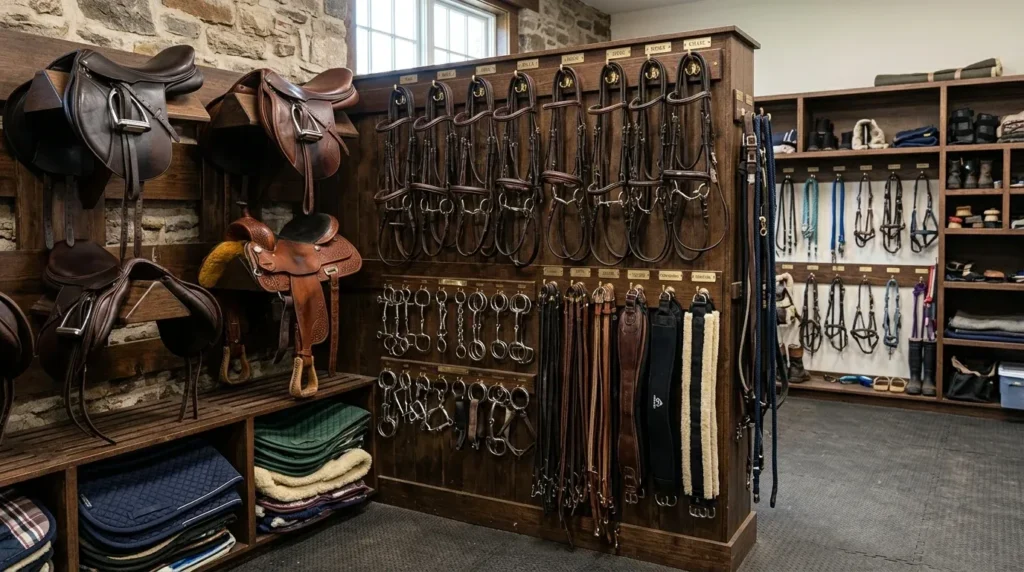
Good tack storage extends product life. Poor storage damages even expensive equipment. Saddles should be stored on suitable racks that support their shape. Bridles should hang without twisting. Bits should be cleaned and dried. Rugs should be folded or hung properly after drying. Damp, dusty, and overheated tack rooms create problems quickly.
A basic tack room should include saddle racks, bridle hooks, ventilation, cleaning supplies, dry storage space, rug rails or shelves, clear labels for school equipment, and an inspection log for shared tack.
For riding schools, tack organization improves safety. When each horse has assigned equipment, staff can spot problems faster. If tack is constantly swapped without tracking, fit problems become more likely.
How Horse Tack Connects With Apparel and Wider Equestrian Gear
Horse tack does not exist alone. Riders often buy tack together with riding apparel, base layers, breeches, jackets, gloves, stable wear, teamwear, and branded merchandise. For equestrian brands, this creates an opportunity to build complete product ranges instead of selling single items.
A riding school may need bridles, saddle pads, rugs, instructor jackets, stable uniforms, and team apparel. A private label brand may need leather tack, riding breeches, branded packaging, and seasonal gear. A wholesaler may need both horse products and rider apparel to supply retailers with a complete range.
GHC Sportswear® also supports wider category manufacturing, including women’s sportswear, men’s sportswear, and women’s yoga wear. These categories matter because many equestrian brands also sell lifestyle apparel, training wear, and casual riding-related products.
Cross-Category Manufacturing for B2B Buyers
Many B2B buyers do not operate in one category only. A distributor may sell equestrian products, sports uniforms, motorcycle gear, and activewear. A startup may begin with rider apparel and later expand into tack or stable wear. A sportswear brand may add equestrian teamwear or club merchandise.
For teamwear and club-related buyers, GHC Sportswear® provides a dedicated custom wholesale sports uniforms manufacturer page. This is useful for equestrian clubs, riding teams, and event organizers that need branded team apparel alongside horse tack.
For motorcycle and protective gear buyers, GHC Sportswear® also offers custom wholesale motorbike gear manufacturing. This matters for distributors who manage multiple protective apparel categories and need one manufacturing partner for different performance gear lines.
Why the Manufacturer Matters
Horse tack production requires more than basic stitching. Buyers need a manufacturer that understands material performance, fit requirements, hardware quality, branding, packaging, repeat orders, and bulk consistency.
A strong manufacturing partner should provide:
- Clear communication
- Sample development
- Material guidance
- Branding support
- Quality checks
- Repeat production systems
- Scalable order handling
- Packaging options
- Product category knowledge
GHC Sportswear® explains its background and manufacturing approach on the about us page. This helps buyers understand the company before starting a B2B conversation.
Complete Horse Tack Guide for Internal Linking and SEO Clusters
This horse tack pillar should become the central page for all tack-related articles on the website. Every supporting article should link back to this guide because it explains the full topic. This helps readers move from one specific problem to the wider tack education page.
Supporting articles can include:
- Why Your Saddle Keeps Slipping
- Bridle Doesn’t Fit? Here’s What Most Riders Get Wrong
- Horse Keeps Rejecting the Bit
- Cheap Tack vs Quality Tack
- Why Your Leather Tack Cracks So Fast
- Leather vs Synthetic Horse Tack
- Cheap vs Premium Saddles
- Signs Your Horse Hates Your Tack
- If Horses Could Talk – What They’d Say About Your Saddle
- Best Tack Storage Ideas for Riding Schools
- How Often Should You Replace a Horse Bridle?
Each supporting article should also link to one closely related article. For example, a bridle fit article can link to a bit rejection article. A leather cracking article can link to leather vs synthetic tack. A saddle slipping article can link to cheap vs premium saddles. This creates a strong topic cluster rather than isolated posts.
Need a Reliable B2B Horse Tack and Equestrian Gear Partner?
GHC Sportswear® works with equestrian brands, riding schools, wholesalers, distributors, retailers, and private label businesses that need reliable horse tack and equestrian gear production.
We support:
- Custom horse tack manufacturing
- Leather and synthetic gear options
- Bulk equestrian gear supply
- Private label product development
- Branded packaging and labeling
- Repeat production for growing businesses
- Quality control for bulk orders
- Scalable supply for riding schools and retailers
- Cross-category support for equestrian apparel, sportswear, uniforms, yoga wear, and motorbike gear
If you are building an equestrian brand, supplying riding schools, expanding your horse tack product range, or sourcing wholesale equestrian gear, GHC Sportswear® can support your production needs with consistent manufacturing and B2B-focused service.
To discuss custom horse tack, equestrian gear, apparel, or wholesale production, contact GHC Sportswear® here: Contact GHC Sportswear®
WhatsApp: https://wa.me/ghcsportswear
Email: info@ghcsportswar.com
Complete Horse Tack Guide: Final Thoughts
Horse tack should never be selected only by appearance or price. Fit, comfort, durability, safety, material quality, maintenance, and production consistency all matter. A good tack system supports the horse, improves rider communication, and reduces long-term problems.
For riders, the best approach is to observe the horse, check fit regularly, maintain equipment properly, and avoid ignoring signs of discomfort. For riding schools, retailers, wholesalers, and equestrian brands, the best approach is to source consistent, durable, and repeatable products from reliable suppliers.
This complete horse tack guide will act as the main horse tack pillar. Future blogs about saddle slipping, bridle fit, bit rejection, leather vs synthetic tack, cheap vs quality tack, saddle materials, tack maintenance, horse rugs, and tack storage should link back here so the full horse tack cluster becomes stronger over time.