Compression Clothing: Benefits, Uses, and Manufacturing Guide for Sportswear Brands
Compression clothing has become a major category in modern sportswear because athletes, fitness customers, teams, and activewear brands want apparel that feels supportive, close-fitting, and performance-focused. From compression shirts and tights to socks, sleeves, shorts, and base layers, these garments are now used across running, cycling, gym training, football, basketball, recovery routines, and team sports.
But compression clothing should not be treated as a magic product.
It can support comfort, muscle stability, blood flow support, and post-exercise recovery, but it does not guarantee better performance or prevent injuries by itself. The real value depends on fit, pressure level, fabric quality, stitching, stretch recovery, breathability, and the way the product is used.
For sportswear brands, wholesalers, distributors, retailers, teams, clubs, academies, and private label businesses, compression clothing is a strong product category. Customers like it because it feels technical. Businesses like it because it can be sold across multiple sports and fitness markets.
This guide explains how compression clothing works, what benefits are supported by research, where it is commonly used, what fabrics matter, and what B2B buyers should check before manufacturing custom compression sportswear.
What Is Compression Clothing?
Compression clothing refers to tight-fitting sportswear designed to apply pressure to specific areas of the body. It is usually made with stretch fabrics that fit close to the skin without completely restricting movement.
Common compression clothing products include:
- Compression shirts
- Compression tights
- Compression shorts
- Compression socks
- Compression sleeves
- Compression leggings
- Base layers
- Recovery wear
- Compression arm sleeves
- Compression calf sleeves
- Compression sports bras
- Compression training tops
The purpose is to provide a supportive fit. Depending on the product, compression clothing may help reduce muscle movement, support circulation, improve body muscle movement, support circulation, improve body awareness, and feel more stable during training.
Cleveland Clinic explains that compression therapy works by applying pressure and can help improve blood flow, especially in the lower legs. This is useful background for understanding compression garments, although athletic compression clothing should not be marketed as medical treatmvant medical requirements.
For sportswear brands, this distinction matters. Compression sportswear can be performance apparel, but medical claims require proper testing, certification, and compliance.
How Compression Clothing Works
Compression clothing works through controlled pressure and close contact with the body. The exact effect depends on the garment type, compression level, fabric, fit, and activity.
The main mechanisms include:
- External pressure on muscles
- Reduced muscle vibration during movement
- Close fit that supports body awareness
- Stretch recovery that keeps the garment in place
- Moisture-wicking fabric for sweat control
- Supportive fabric structure around active areas
Compression clothing is usually made from synthetic stretch fabrics such as nylon-spandex, polyester-spandex, or elastane blends. These fabrics allow the garment to stretch, recover, and maintain pressure.
A good compression product should feel firm but not painful. It should support movement without cutting into the skin, blocking circulation, or causing discomfort.
That is why size grading is critical. If compression clothing is too tight, it can feel restrictive. If it is too loose, it loses its purpose.
Compression Clothing and Athletic Performance
Athletes often wear compression clothing because it feels supportive during training. The close fit can reduce loose fabric movement and help the athlete feel more stable.
Compression clothing may support performance comfort by helping with:
- Muscle support
- Reduced garment movement
- Better body awareness
- Sweat control
- Lightweight layering
- Reduced friction from loose fabric
- Warmth in cooler conditions
However, brands should avoid exaggerated claims. Research does not show that compression clothing automatically improves every performance measure for every athlete.
A review on compression garments explains that athletes commonly use them to improve performance, reduce fatigue responses, and support recovery, but the effects can vary depending sport, and timing of use.
For B2B buyers, the safe message is clear: sell compression clothing as supportive performance apparel, not as a guaranteed performance booster.
Compression Clothing and Recovery
One of the strongest reasons athletes use compression clothing is recovery comfort after training or competition. Compression garments are often worn after exercise to support recovery routines.
Research published in the Journal of Exercise Rehabilitation found that wearing compression garments during the post-exercise period helped reduce delayed-onset muscle soreness and supportnction in the study group.
A newer 2025 study also found that compression garments showed benefits in mitigating some declines in muscle strength and power after exercise-induced fatigue, although re intervals and conditions. pcm.ncbi
This means compression clothing can be useful for recovery-focused products, but claims should stay realistic.
Good wording for brands includes:
- May support post-training recovery comfort
- Designed for muscle support
- Helps provide a secure compression fit
- Suitable for training and recovery routines
- Supports comfort after intense activity
Avoid claims such as:
- Guaranteed recovery
- Prevents all soreness
- Eliminates fatigue
- Prevents injury
- Medical-grade treatment unless certified
Key Benefits of Compression Clothing
Compression clothing can offer several practical benefits when designed and fitted correctly.
Muscle support
Compression clothing provides a close, supportive fit around active muscle groups. This can make athletes feel more stable during movement.
This is useful in running, gym training, cycling, basketball, football, and high-intensity training.
Reduced muscle vibration
During movement, muscles can vibrate or oscillate. Compression clothing may help reduce this feeling by holding the muscle area more firmly.
This can improve comfort during repeated movement such as running, jumping, sprinting, or lifting.
Recovery comfort
Compression clothing is often used after training to support recovery routines. Athletes may wear compression tights, socks, sleeves, or tops after intense sessions.
Sweat control
Most compression clothing uses moisture-wicking fabrics. This helps move sweat away from the skin and keeps the garment feeling lighter during training.
Better layering
Compression tops and tights are often used as base layers under team uniforms, jackets, outerwear, or sports kits.
Reduced fabric distraction
Loose clothing can move around during exercise. Compression clothing stays closer to the body, which can reduce distraction in certain sports.
Compression Clothing vs Regular Sportswear
Compression clothing is different from regular sportswear because of its fit, fabric, and purpose.
| Feature | Regular Sportswear | Compression Clothing |
|---|---|---|
| Fit | Relaxed or athletic | Close and supportive |
| Fabric | Breathable, durable, flexible | High stretch and strong recovery |
| Main Purpose | Comfort and movement | Support, stability, and recovery comfort |
| Best Use | General training and daily sportswear | High-movement training and base layers |
| Sizing Risk | Basic fit issues | Pressure and comfort issues |
| Fabric Need | Standard performance fabric | Strong stretch recovery and shape control |
Regular sportswear is easier to size. Compression clothing requires more careful fit development because the garment must apply pressure without discomfort.
For brands, this makes sampling and testing essential.
Best Fabrics for Compression Clothing
Fabric selection is one of the most important parts of compression clothing production. The fabric must stretch, recover, breathe, wick sweat, and maintain shape after washing.
Common fabric options include:
| Fabric Type | Best Use | Main Benefit |
|---|---|---|
| Nylon-spandex | Tights, leggings, sports bras, sleeves | Smooth feel and strong stretch recovery |
| Polyester-spandex | Shirts, base layers, shorts | Moisture control and durability |
| Recycled nylon blend | Sustainable compression wear | Stretch with lower-impact positioning |
| Recycled polyester blend | Compression tops and teamwear | Performance with eco-conscious sourcing |
| Power mesh | Panels and ventilation zones | Support and breathability |
| Compression knit | High-support garments | Firm structure and shape control |
A compression shirt does not need the same fabric as compression tights. A compression sock does not need the same structure as a sports bra. Each product needs its own fabric and pattern planning.
GHC Sportswear® can help brands and teams select suitable performance fabrics through its custom sportswear manufacturing services.
Compression Clothing for Different Sports
Compression clothing can be used in many sports, but the product design should match the activity.
| Sport or Activity | Common Compression Product | Main Requirement |
|---|---|---|
| Running | Compression socks, tights, shorts | Leg support and sweat control |
| Cycling | Compression shorts, base layers | Close fit and movement comfort |
| Gym training | Compression shirts, shorts, tights | Stretch and muscle support |
| Football | Base layers, compression shorts | Layering under uniforms |
| Basketball | Compression tights, sleeves | Movement and support |
| Weightlifting | Compression tops, tights, sleeves | Stability and fit |
| Yoga and pilates | Compression leggings and bras | Stretch, softness, and coverage |
| Recovery use | Socks, sleeves, tights | Post-training comfort |
For teamwear buyers, compression clothing is often used under uniforms. Football, basketball, rugby, cricket, and baseball players may wear compression shorts, tights, or base layers during training and games.
Relevant teamwear categories can be reviewed on the custom wholesale sports uniforms manufacturer page.
Compression Clothing for Running
Runners commonly use compression socks, calf sleeves, shorts, and tights. These products are designed to feel supportive during repeated impact and long-distance movement.
A good running compression product should provide:
- Lightweight fabric
- Strong stretch recovery
- Moisture control
- Breathability
- Flat seams
- Secure waistband
- Comfortable leg openings
- Reflective details where needed
Compression socks and sleeves are especially popular with runners because the lower legs handle repeated impact. However, brands should be careful not to promise injury prevention without evidence.
Better wording is: “designed to support lower-leg comfort during running.”
Compression Clothing for Gym and Fitness Training
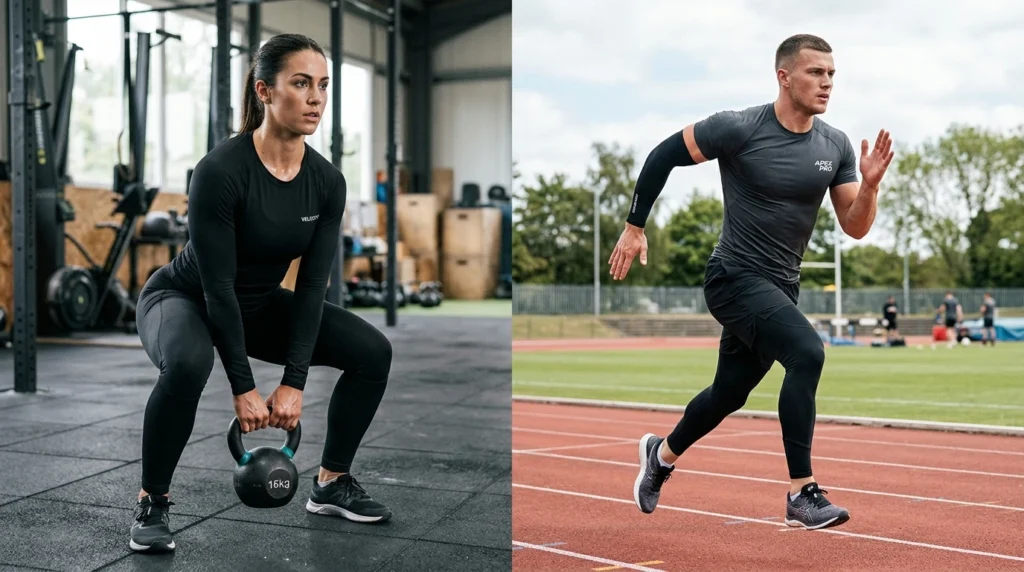
In gym environments, compression clothing is used for strength training, HIIT, functional fitness, and general workouts.
Common products include:
- Compression shirts
- Compression shorts
- Compression leggings
- Compression sports bras
- Arm sleeves
- Base layers
Gym customers usually care about:
- Squat-proof coverage
- Stretch recovery
- Sweat control
- Fit stability
- Seam comfort
- Strong waistband construction
- Durability after washing
Women’s activewear buyers can explore relevant categories on the custom wholesale women’s sportswear manufacturer page, while men’s compression and training apparel buyers can review the custom wholesale men’s sportswear manufacturer page.
Compression Clothing for Yoga and Studio Wear
Compression clothing is also used in yoga, pilates, barre, and studio training. In these categories, the compression should usually feel supportive but not too aggressive.
Yoga customers want:
- Soft stretch
- Squat-proof coverage
- Smooth hand feel
- Waistband comfort
- Breathability
- Flexible movement
- No see-through fabric
- No harsh seams
Compression leggings and sports bras are strong products for yoga and studio brands. However, heavy compression may not suit every yoga customer. Some brands prefer soft compression instead of firm compression.
Relevant product options are available on the custom wholesale women’s yoga wear manufacturer page.
Compression Clothing as Base Layershttps://ghcsportswear.com/custom-wholesale-womens-yoga-wears-manufacturer/
Base layers are one of the most practical uses for compression clothing. Athletes wear them under uniforms, jackets, or outerwear.
Compression base layers can help with:
- Sweat control
- Layering comfort
- Warmth in cooler conditions
- Reduced fabric bulk
- Supportive fit
- Team uniform consistency
For football, rugby, cricket, and basketball teams, compression base layers can be produced in team colors. This helps maintain a clean, coordinated look.
For B2B buyers, base layers are a strong add-on product because teams may order them alongside uniforms, training kits, and outerwear.
Fit and Sizing in Compression Clothing
Fit is the most important part of compression clothing. A regular T-shirt can be slightly loose and still work. A compression shirt cannot.
Compression clothing should be:
- Snug but not painful
- Supportive but not restrictive
- Close-fitting without cutting into skin
- Flexible enough for movement
- Stable during training
- Comfortable after washing
Size grading must be accurate across the full size range. If only the medium sample fits well, the bulk order may still fail in small, large, and plus sizes.
Important fit areas include:
- Chest
- Shoulders
- Waist
- Hips
- Thighs
- Calves
- Arms
- Knees
- Ankles
- Neck opening
- Waistband
For B2B buyers, fit testing should include movement. Athletes should squat, run, stretch, lift, jump, and rotate while wearing the garment.
Compression Level: Why Pressure Matters
Compression clothing is not only about tightness. Pressure must be controlled.
Too little pressure means the garment works like basic stretch apparel. Too much pressure can cause discomfort and may be unsafe for some users.
Medical compression garments may use measured pressure levels, but sports compression apparel is often developed around fit, fabric tension, and pattern structure.
For sportswear brands, the safest approach is to describe the product accurately:
- Light compression
- Medium compression
- Firm compression
- Supportive compression fit
- Close-to-body fit
If a brand wants to claim medical-grade pressure, that requires proper testing and compliance.
Moisture-Wicking and Breathability
Compression clothing sits close to the skin, so sweat management is critical. Poor fabric can make the garment feel hot, sticky, and uncomfortable.
Good compression clothing should offer:
- Moisture-wicking fabric
- Quick-drying performance
- Breathable panels
- Mesh zones where needed
- Lightweight construction
- Comfortable seams
A compression shirt for high-intensity training should not use the same fabric as casual lifestyle wear. A compression tight for running needs different breathability than a recovery tight worn after training.
Fabric choice should match the use case.
Durability and Wash Performance
Compression clothing must hold its shape after repeated use. If the fabric loses recovery, the garment no longer feels supportive.
Durability depends on:
- Fiber quality
- Elastane content
- Knit structure
- Stitching quality
- Seam strength
- Waistband construction
- Wash care
- Fabric finishing
- Print method
Common durability problems include:
- Sagging after washing
- Loose waistband
- Pilling
- Seam popping
- Fabric thinning
- Loss of compression
- Color fading
- Logo cracking or peeling
For sportswear brands, these issues create returns and bad reviews. For teams, they create replacement costs.
A good manufacturer should guide buyers on fabric testing and sample approval before bulk production.
Compression Clothing and Sustainability
Sustainability is becoming more important in compression clothing because many compression fabrics use synthetic fibers.
More responsible options may include:
- Recycled polyester
- Recycled nylon
- Durable fabric construction
- Better cutting efficiency
- Reduced packaging
- Long-lasting product design
- Lower-impact dyeing where available
Sustainability should not weaken performance. A recycled compression fabric still needs stretch recovery, breathability, opacity, and wash durability.
For brands, the best sustainability claim is a practical one: make products that last longer, reduce waste, and use better material options where possible.
Smart Compression Clothing and Future Trends
Compression clothing is also connected to future smart sportswear. Researchers and brands are exploring textiles with sensors that can monitor movement, strain, heart rate, breathing, and muscle activity.
A 2025 review on smart and wearable textiles explains that functional textiles are increasingly being developed for applications such as health ing, and wearable sensing. citeturn632378search4
For commercial sportswear brands, smart compression clothing is still developing. Challenges include cost, washing durability, sensor accuracy, comfort, and mass production.
Future compression clothing may include:
- Sensor-integrated base layers
- Muscle activity tracking
- Posture feedback
- Recovery monitoring
- Heat and sweat tracking
- Connected training apparel
- Personalized compression mapping
For most brands today, the priority should still be fabric quality, fit, durability, and real customer use.
Custom Compression Clothing vs Generic Compression Wear
Generic compression wear may be easy to buy, but it gives brands less control.
| Area | Generic Compression Wear | Custom Compression Clothing |
|---|---|---|
| Fit | Standard sizing only | Brand-specific size grading |
| Fabric | Limited options | Fabric selected by sport and use |
| Branding | Basic or no branding | Logos, labels, colors, packaging |
| Compression Feel | Pre-set | Can be developed by product type |
| Design | Common market styles | Unique brand identity |
| Quality Control | Depends on stock supplier | Managed through sampling and production |
| Repeat Orders | Stock may change | More consistent production planning |
For private label brands, custom compression clothing creates better control over product identity and quality.
B2B Buyer Checklist Before Ordering Compression Clothing
Before manufacturing compression clothing, buyers should confirm the following:
- Product type
- Target sport or activity
- Fabric composition
- GSM weight
- Stretch percentage
- Compression level
- Size chart
- Gender or youth fit requirements
- Moisture-wicking performance
- Breathability
- Seam type
- Waistband construction
- Logo method
- Packaging requirements
- Sample approval
- Wash testing
- Repeat production plan
This checklist helps avoid expensive mistakes.
Compression clothing is technical. It should not be developed only from a photo or a basic mockup.
Common Mistakes in Compression Clothing Manufacturing
Many brands make mistakes when developing compression wear.
Common mistakes include:
- Making the garment too tight
- Using weak elastane fabric
- Ignoring stretch recovery
- Poor size grading
- No movement testing
- No wash testing
- Weak waistband construction
- See-through leggings or tights
- Heavy seams that irritate skin
- Making unsupported injury-prevention claims
- Choosing fabric only by price
- Not planning repeat production
The biggest mistake is assuming tight clothing is compression clothing. Real compression clothing requires fabric control, pattern accuracy, and proper testing.
How GHC Sportswear® Supports Compression Clothing Production
GHC Sportswear® supports sportswear brands, teams, clubs, academies, wholesalers, distributors, retailers, gym brands, and private label businesses with custom compression clothing manufacturing.
GHC Sportswear® can help with:
- Compression shirts
- Compression tights
- Compression shorts
- Compression leggings
- Compression sleeves
- Compression base layers
- Sports bras
- Training tops
- Team base layers
- Private label compression wear
- Custom logos
- Labels and packaging
- Fabric sourcing
- Product sampling
- Bulk production
Buyers can explore wider apparel options through the GHC Sportswear® products page and manufacturing support through the GHC Sportswear® services page.
For brands that want a deeper production overview, the custom sportswear manufacturing guide is also a useful internal resource.
Need Custom Compression Clothing for Your Brand or Team?
If you are launching a compression wear line, creating gym apparel, supplying teams, building private label activewear, or adding performance base layers to your sportswear range, GHC Sportswear® can help you develop custom compression clothing for real business use.
GHC Sportswear® works with:
- Sportswear brands
- Fitness startups
- Gym apparel brands
- Sports teams
- Clubs
- Academies
- Wholesalers
- Distributors
- Retailers
- Yoga brands
- Private label businesses
- Team uniform suppliers
GHC Sportswear® provides support for fabric selection, product development, compression fit planning, custom designs, branding, labels, packaging, sampling, size grading, and bulk manufacturing.
For B2B buyers, the goal is not only to make tight sportswear. The goal is to create compression clothing that fits correctly, supports movement, feels comfortable, holds shape, and can be produced consistently.
Contact GHC Sportswear® for custom compression clothing manufacturing:
WhatsApp: https://wa.me/ghcsportswear
Email: info@ghcsportswar.com
Contact page: GHC Sportswear® contact us
Conclusion
Compression clothing has become an important part of modern sportswear because it offers a supportive fit, recovery comfort, sweat control, and practical layering for athletes and active customers.
It can be useful for running, gym training, cycling, football, basketball, yoga, team sports, and recovery routines. But it should be marketed responsibly. Compression clothing may support comfort, muscle stability, and recovery, but it should not be described as injury-proof or guaranteed performance gear.
For brands, wholesalers, distributors, teams, clubs, retailers, and private label businesses, compression clothing is a strong product category when it is developed properly.
The best compression products depend on correct fabric, accurate sizing, strong stretch recovery, breathability, durable stitching, and realistic product claims.
GHC Sportswear® helps B2B buyers manufacture custom compression clothing that is practical, professional, and suitable for real sportswear markets.
Related Blog:
Custom Sportswear Manufacturing Guide: https://ghcsportswear.com/custom-sportswear-manufacturing-guide/