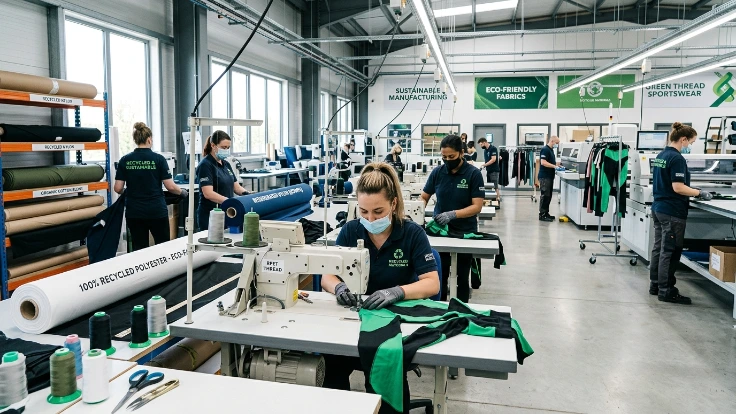
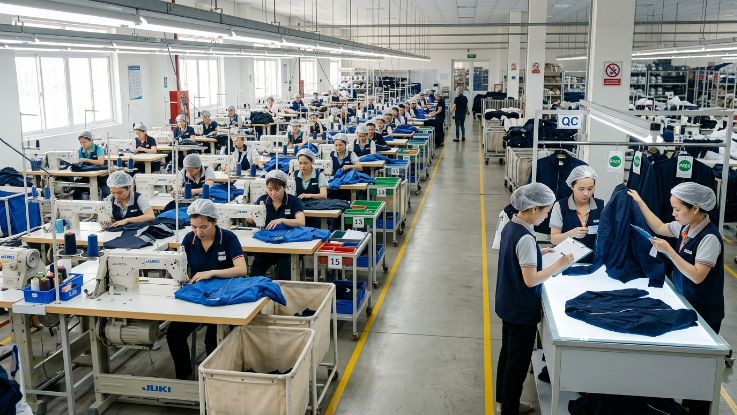
Controlled Manufacturing: Why 70% of Production Issues Start on the Floor
Most brands assume apparel production problems begin with poor design, an incomplete tech pack or incorrect material sourcing.
Those factors matter. However, even a fully approved design, tested fabric, correct trims and final pre-production sample can fail when execution is not controlled on the factory floor.
The cutting team can mix shade lots.
An operator can use the wrong stitch specification.
A measurement can drift gradually during a long production run.
A logo can move several centimetres from its approved position.
A line supervisor can miss a recurring defect.
An end-line inspector can find the problem only after hundreds of garments have already been completed.
That is why controlled manufacturing matters.
It converts approved product information into repeatable physical output through defined instructions, trained operators, controlled measurements, production checkpoints, traceability and immediate corrective action.
“Production quality is not created during final inspection. It is protected at every operation before final inspection.”
For apparel brands, retailers, wholesalers, distributors, sports teams and private label businesses, manufacturing control is not simply a factory concern. It directly affects delivery reliability, inventory consistency, customer returns and brand reputation.
GHC Sportswear® supports brands through apparel product planning, fabric and trim sourcing, apparel sampling, custom product development, controlled bulk manufacturing, private label production and repeat-order planning.
A Responsible Explanation of the 70% Claim
The claim that “70% of production issues start on the floor” should not be presented as a universal industry law.
There is no single verified global study proving that exactly 70% of all garment defects begin during factory-floor execution across every country, factory and product category.
The percentage is more responsibly used as:
- A factory diagnostic hypothesis
- An internal defect-reduction target
- A process-control KPI
- A measurable comparison between planning-related and execution-related problems
A manufacturer can establish the real percentage by classifying every defect according to its root cause.
Production-Issue Source Formula
Factory-floor issue rate =
Execution-related defects ÷ Total investigated defects × 100
Example:
| Root-Cause Category | Recorded Issues |
|---|---|
| Product planning and specifications | 12 |
| Fabric and trim sourcing | 18 |
| Sampling and approval | 10 |
| Cutting, sewing, finishing and packing | 70 |
| Total | 110 |
In this example, factory-floor execution caused approximately 63.6% of investigated issues—not 70%.
Another factory may record 45%, 70% or 80%. The correct percentage must come from documented production data.
The title’s 70% figure should therefore be treated as a serious control target: investigate whether most defects are being created during cutting, sewing, finishing, inspection or packing, and then reduce them systematically.
Direct Answer: What Is Controlled Manufacturing?
Controlled manufacturing is a production system in which every critical stage follows approved specifications, standard operating procedures, measurable quality requirements and documented inspection checkpoints.
In apparel production, it covers:
- Production-file control
- Fabric and trim verification
- Cutting-room control
- Bundle and shade tracking
- Machine setup
- Operator instructions
- First-piece approval
- In-line inspection
- Measurement checks
- End-line quality control
- Finishing inspection
- Packing verification
- Nonconformance reporting
- Root-cause analysis
- Corrective action
- Production traceability
- Final random inspection
- Reorder documentation
Controlled manufacturing does not mean inspecting every garment only at the end.
It means making the process capable of producing the correct garment repeatedly.
Quality Control Is a System, Not a Department
A common factory mistake is treating quality as the responsibility of inspectors alone.
Quality is also affected by:
- Merchandising
- Pattern development
- Fabric inspection
- Cutting
- Printing
- Embroidery
- Sewing
- Finishing
- Packing
- Maintenance
- Production planning
- Line supervision
- Warehouse control
The ISO explanation of a quality management system describes a QMS as:
“A clearly defined set of processes and responsibilities that makes your business run how it’s supposed to.”
ISO 9001 provides a globally recognized framework for establishing, maintaining and continually improving such quality-management processes.
A final inspector cannot compensate for an uncontrolled production system. The inspector can identify defects, but the process must prevent them.
Why Production Problems Appear on the Factory Floor
Product specifications remain theoretical until production begins.
Once bulk manufacturing starts, multiple variables enter the process:
- Different operators
- Different machines
- Different fabric rolls
- Different dye lots
- Machine-speed changes
- Needle wear
- Thread-tension changes
- Operator fatigue
- Production pressure
- Shift changes
- Measurement variation
- Handling damage
- Communication gaps
- Repair work
- Mixed bundles
- Packing mistakes
Every uncontrolled variable increases risk.
A production line may begin correctly but drift over time. That is why a first approved garment is not enough. Production must be monitored throughout the order.
The Factory-Floor Risk Map
| Production Stage | Typical Failure | Business Consequence |
| Material receiving | Wrong fabric or trim accepted | Incorrect product enters production |
| Fabric inspection | Defects or shade variation missed | Damaged panels or colour mismatch |
| Relaxation | Fabric cut before stabilizing | Measurement distortion |
| Pattern and marker | Incorrect version used | Entire cut quantity affected |
| Cutting | Inaccurate or mixed panels | Poor garment assembly |
| Bundling | Sizes, shades or components mixed | Inconsistent finished garments |
| Printing | Position or colour varies | Branding rejection |
| Embroidery | Density or placement incorrect | Fabric distortion and rework |
| Sewing | Seam, stitch or measurement varies | Fit and durability problems |
| In-line QC | Defect trend not identified | Hundreds of repeated defects |
| Finishing | Stains, loose threads or damage | Poor presentation |
| Measurement | Wrong method or tool | False pass or rejection |
| Packing | Wrong size, label or quantity | Retail and fulfilment errors |
| Final inspection | Sampling applied incorrectly | Poor shipment decision |
| Corrective action | Symptoms repaired without root cause | Defect returns later |
Controlled manufacturing creates a checkpoint around each risk.
The Seven Control Gates of Apparel Manufacturing
A robust factory system can be structured around seven control gates.
Gate 1: Production File Release
No production line should begin from scattered messages, old artwork or memory.
The controlled production file should include:
- Final tech pack
- Approved measurement chart
- Point-of-measurement guide
- Approved pre-production sample
- Fabric specification
- Bill of materials
- Trim card
- Colour approvals
- Artwork files
- Print or embroidery placement
- Size breakdown
- Packing instructions
- Quality requirements
- Revision number
- Approval record
Only the latest controlled version should reach production.
Document-Control Risk
Suppose the buyer approved sample version five, but the cutting department receives the pattern from version three.
The production team may execute perfectly and still manufacture the wrong garment.
Document control prevents outdated information from entering production.
Gate 2: Incoming Material Control
Before cutting or assembly, fabric and trims should be checked against approved references.
Control points may include:
- Fabric construction
- Fibre composition documentation
- GSM
- Width
- Shade
- Dye lot
- Stretch
- Recovery
- Shrinkage results
- Visible defects
- Zipper type and length
- Elastic width and recovery
- Thread specification
- Label accuracy
- Hardware finish
- Packaging materials
The full sourcing framework is explained in Fabric and Trim Sourcing: Improve Garment Quality by 60%.
Why Incoming Inspection Matters
Once defective fabric has been cut, its commercial value falls sharply.
Once the wrong zipper has been stitched into 1,000 jackets, correction becomes expensive.
Incoming inspection stops unsuitable materials before labour is added.
Gate 3: Cutting-Room Control
Cutting errors have a multiplying effect because one incorrect marker, pattern or lay can affect hundreds of pieces.
A controlled cutting room should manage:
- Fabric relaxation
- Roll identification
- Shade segregation
- Marker version
- Lay height
- Fabric direction
- Pattern alignment
- Stripe or check matching
- Notches
- Drill marks
- Cutting accuracy
- Panel numbering
- Bundle quantity
- Size identification
- Replacement panels
- Cut-panel inspection
Shade Control
Fabric panels from different dye lots should not be mixed randomly.
A jacket body cut from one shade and sleeves cut from another may look acceptable under factory lighting but visibly mismatched in daylight.
Shade grouping and bundle traceability help prevent this problem.
Panel Numbering
Numbering cut panels keeps matching components together.
This is especially useful for:
- Dyed fabrics
- Printed fabrics
- Washed garments
- Sublimated panels
- Matching tracksuits
- Striped products
- Premium outerwear
Gate 4: Line Setup and First-Piece Approval
A line should not immediately begin full-speed production.
The first finished pieces should be checked against:
- Approved sample
- Measurement chart
- Stitch specification
- Seam construction
- Thread colour
- Trim placement
- Logo position
- Label position
- Workmanship requirements
- Pressing standard
- Appearance standard
This is often called:
- First-piece approval
- First-off approval
- Pilot run
- Line-setting sample
- Initial production approval
Why First-Piece Approval Works
A wrong operation detected after five garments is manageable.
The same wrong operation detected after 500 garments becomes a major rework problem.
Gate 5: In-Line Process Control
In-line inspection happens while garments are being manufactured.
It should identify trends, not only isolated defects.
Inspectors and supervisors should look for:
- Skipped stitches
- Broken stitches
- Uneven seams
- Seam puckering
- Incorrect seam allowance
- Twisted sleeves or legs
- Uneven hems
- Incorrect labels
- Wrong components
- Print or embroidery misplacement
- Measurement drift
- Oil marks
- Needle damage
- Panel mismatch
- Repeated operator defects
The Stop-and-Correct Principle
When a repeated defect appears, the line should not continue producing it while inspectors repair garments at the end.
The correct response is:
- Identify the defect.
- Contain affected work.
- Identify the operation causing it.
- Correct the machine, method, material or instruction.
- Retrain the operator where needed.
- Verify the correction.
- Restart controlled production.
- Reinspect the affected quantity.
That is process control.
Repairing defects without correcting the source is only defect management.
Gate 6: End-Line and Finishing Control
End-line inspection verifies complete garments before finishing and packing.
Checks may include:
- Garment appearance
- Measurements
- Workmanship
- Stitching
- Seam security
- Symmetry
- Logo placement
- Label accuracy
- Colour and shade
- Trims
- Cleanliness
- Function
- Loose threads
- Pressing
- Damage
Finishing control should also manage:
- Thread trimming
- Stain removal
- Pressing temperature
- Shape restoration
- Folding
- Metal detection where required
- Needle-control procedures
- Hang tags
- Stickers
- Size identification
Gate 7: Packing and Shipment Verification
A correctly manufactured garment can still create a customer complaint if it is packed incorrectly.
Packing control should confirm:
- Correct product
- Correct colour
- Correct size
- Correct size sticker
- Correct barcode
- Correct hang tag
- Correct care label
- Correct folding
- Correct polybag
- Correct assortment ratio
- Correct carton quantity
- Correct carton marks
- Correct destination
- Correct documentation
Retailers and distributors often receive products through warehouses rather than directly from production. A packing error can therefore create inventory, fulfilment and customer-service problems even when garment quality is acceptable.
Standard Work: Making Quality Repeatable
Controlled manufacturing depends on standard work.
A standard operating procedure should define:
- What operation must be performed
- Which machine is used
- Which attachment is required
- Which needle and thread are required
- What seam allowance is required
- What stitch density is required
- How the operation is checked
- What defect is unacceptable
- Who approves the operation
- What happens when the result is incorrect
Standard work reduces variation between operators and shifts.
The ILO has promoted lean manufacturing and industrial engineering in garment factories to eliminate waste, measure productivity and optimize operations. Its research on Asian garment manufacturing also identifies standard procedures, production control, quality control and information systems as important productivity factors.
Standard Work Does Not Remove Skill
Standardization does not mean operators become unimportant.
It gives skilled workers:
- Clear requirements
- Correct tools
- Approved methods
- Stable machine settings
- Measurable targets
- Faster problem reporting
- Better training support
The objective is not to make every person identical. It is to prevent product quality from depending on uncontrolled individual interpretation.
Supervisor Quality Has a Measurable Effect
Production supervisors connect planning, people, output and quality.
Their responsibilities include:
- Line balancing
- Work allocation
- Operator support
- Hourly target monitoring
- Defect response
- Training
- Communication
- Bottleneck management
- WIP control
- Corrective action
- Escalation
Better Work reports that supervisors participating in its Supervisory Skills Training reached hourly targets an average of 11 minutes faster, translating into an estimated 22% productivity increase in that programme. This is programme-specific evidence, not a universal result, but it demonstrates how floor-level supervision and communication can materially affect performance.
A fast operator cannot compensate for a badly balanced line.
A skilled supervisor helps the full line work as a system.
Measurement Control: One Centimetre Can Become a Bulk Problem
Garment measurements may vary because of:
- Fabric stretch
- Fabric relaxation
- Sewing tension
- Seam allowance
- Operator handling
- Pressing
- Washing
- Incorrect measurement method
- Unreliable measuring equipment
- Different interpretations of measurement points
Controlled measurement requires:
- Approved points of measurement
- Garment positioning instructions
- Defined tolerances
- Calibrated or verified tools
- Stable measuring tables
- Trained inspectors
- Consistent tension during measurement
- Recorded results
- Escalation for repeated failures
The current ISO 10012:2026 measurement-management standard establishes requirements intended to provide confidence in the validity and reliability of measurement results used in production and quality verification.
Apparel Measurement Tools
Depending on the product, controlled tools may include:
- Measuring tapes
- Rulers
- Templates
- Scales
- GSM cutters and balances
- Thickness gauges
- Stretch-test fixtures
- Colour-assessment tools
- Temperature equipment
- Pressure equipment
The tool does not need to be complex. It needs to be reliable and suitable for its purpose.
Manufacturing KPIs That Brands Should Request
Production cannot be controlled only through statements such as “quality is good.”
It needs measurable indicators.
The ISO 22400 framework establishes concepts for defining and using manufacturing-operation KPIs. Apparel factories can adapt measurable indicators to their products and production systems.
First-Pass Yield
First-pass yield =
Units passing without repair ÷ Total units inspected × 100
Example:
- 950 garments inspected
- 855 passed without repair
First-pass yield:
855 ÷ 950 × 100 = 90%
A high shipment pass rate can hide poor process performance if many garments were repaired first. First-pass yield exposes that hidden rework.
Defects per Hundred Units
DHU =
Total defects found ÷ Units inspected × 100
Example:
- 150 garments inspected
- 21 total defects found
DHU:
21 ÷ 150 × 100 = 14
One garment may contain more than one defect, so DHU is not the same as defective-garment percentage.
Defective Garment Rate
Defective garment rate =
Garments containing one or more defects ÷ Garments inspected × 100
This tracks affected garments rather than total defect count.
Rework Rate
Rework rate =
Units requiring correction ÷ Total units produced × 100
High rework increases:
- Labour cost
- Handling
- Damage risk
- Delay
- Production congestion
- Hidden quality cost
Right-First-Time Rate
This measures whether work is completed correctly without repair, replacement or repeated processing.
It can be tracked by:
- Operation
- Operator
- Line
- Style
- Shift
- Product category
- Production day
On-Time Completion
On-time completion =
Orders or production stages completed on schedule ÷ Total scheduled × 100
This helps separate real manufacturing reliability from promised speed.
Line Efficiency
A commonly used apparel calculation is:
Line efficiency =
Standard minutes earned ÷ Available production minutes × 100
This can help identify:
- Poor line balance
- Bottlenecks
- Excess idle time
- Skill gaps
- Machine problems
- Unrealistic targets
Efficiency should never be improved by bypassing quality or worker-safety requirements.
The 70% Improvement-Control Model
A brand or factory can use a before-and-after system to test whether controlled manufacturing reduces floor-created issues by 70%.
Baseline Period
Track production for a defined period before introducing new controls.
Record:
- Defect type
- Defect quantity
- Operation
- Operator or workstation
- Line
- Time
- Product style
- Root cause
- Rework time
- Material loss
- Delivery impact
Control Period
Introduce:
- Updated SOPs
- First-piece approval
- Hourly quality checks
- Measurement control
- Operator training
- Supervisor escalation
- Root-cause analysis
- Corrective-action tracking
- Traceability
- Daily production review
Example Result
| Floor-Control Indicator | Before Control | After Control | Relative Change |
| Sewing defects | 1,000 | 300 | 70% reduction |
| Measurement failures | 200 | 60 | 70% reduction |
| Packing errors | 100 | 30 | 70% reduction |
| Rework hours | 500 | 150 | 70% reduction |
| Late-stage defect discovery | 400 | 120 | 70% reduction |
These are example calculations, not universal benchmarks.
Real results should be verified through factory records.
Production Control by Department
Fabric Warehouse
The fabric warehouse should control:
- Supplier
- Fabric code
- Colour
- Dye lot
- Roll number
- Received quantity
- Inspected quantity
- Approved quantity
- Rejected quantity
- Storage conditions
- Issued quantity
- Remaining balance
Trims Warehouse
Trim control should include:
- Approved sample reference
- Supplier
- Colour
- Size
- Quantity
- Inspection result
- Issue record
- Replacement record
- Remaining balance
Cutting Department
Cutting control should include:
- Marker approval
- Pattern revision
- Lay report
- Roll and shade record
- Cut quantity
- Reject quantity
- Replacement panels
- Bundle record
Printing and Embroidery
Control should include:
- Artwork version
- Colour reference
- Placement template
- Size
- Production method
- Machine settings
- First-piece approval
- Batch check
- Wash or adhesion result where required
Sewing Department
Control should include:
- Operation bulletin
- Machine type
- Needle
- Thread
- Stitch type
- Seam allowance
- Stitch density
- Quality checkpoints
- Production target
- Defect response
Finishing Department
Control should include:
- Cleaning
- Thread trimming
- Measurement
- Pressing
- Function checks
- Appearance
- Labels
- Folding
- Packing
Defect Containment: Stop Bad Output from Moving Forward
When a defect is discovered, affected production should be contained.
Containment means:
- Stop suspect work from moving to the next stage
- Identify the affected time period
- Identify relevant bundles or cartons
- Segregate affected products
- Inspect the suspected quantity
- Correct the process
- Verify repaired items
- Document the result
Without traceability, a factory may need to inspect the entire order because it cannot identify the affected quantity.
With traceability, the factory may isolate only the relevant line, bundle, time period or carton.
Root-Cause Analysis: Repairing Is Not Correcting
A repair removes the visible defect.
Corrective action removes the reason the defect occurred.
Example:
Defect: Open side seam
Possible root causes:
- Incorrect machine tension
- Wrong thread
- Damaged needle
- Insufficient seam allowance
- Incorrect stitch density
- Operator method
- Fabric slippage
- Skipped inspection
- Poor machine maintenance
A factory that only resews the seam has repaired the garment.
A factory that identifies and controls the process cause has corrected the system.
Five-Why Example
Why did the label detach?
The stitching did not hold.
Why did the stitching not hold?
The stitch margin was too narrow.
Why was the margin too narrow?
The operator used visual placement without a guide.
Why was there no guide?
The operation sheet did not specify one.
Why was it missing?
The production file was released without an operation-level review.
The visible defect occurred at sewing, but the root cause included document and process control.
Corrective and Preventive Action
A useful corrective-action record should include:
- Defect description
- Product and style
- Quantity affected
- Detection stage
- Immediate containment
- Root cause
- Correction
- Corrective action
- Responsible person
- Target date
- Verification
- Closure status
- Recurrence check
Corrective action is only complete when effectiveness is verified.
In-Line Inspection vs Final Inspection
| Control Method | Purpose | Limitation |
| Operator self-check | Detect immediate operation errors | Depends on training and discipline |
| Patrol inspection | Monitor multiple operations | May miss rapid changes |
| In-line inspection | Catch defects during production | Requires timely correction |
| End-line inspection | Check completed garments | Rework may already be expensive |
| Final random inspection | Support shipment decision | Does not improve completed production |
| Internal audit | Test whether systems are followed | Must lead to action |
The current ISO 19011:2026 auditing guidance supports consistent management-system auditing and continual improvement.
AQL Is Not a Substitute for Manufacturing Control
Acceptance sampling is commonly used to assess a production lot before shipment.
The current ISO 2859-1:2026 standard defines acceptance sampling plans for inspection by attributes.
However, buyers and factories should understand what AQL does and does not mean.
AQL:
- Supports a lot-acceptance decision
- Defines sampling and acceptance rules
- Helps structure final inspection
- Does not inspect every garment
- Does not guarantee zero defects
- Does not replace in-line process control
- Does not authorize factories to deliberately produce defects
A shipment may pass a final sample inspection while still having experienced high internal rework.
That is why brands should ask for process indicators as well as final inspection results.
Manufacturing-Control Dashboard for B2B Buyers
| KPI | What It Reveals |
| First-pass yield | How much production passes without repair |
| DHU | Number of defects per 100 inspected units |
| Defective rate | Percentage of garments affected |
| Rework rate | Hidden correction workload |
| Cut-to-ship ratio | Material and production conversion |
| Measurement failure rate | Fit-control performance |
| On-time completion | Schedule reliability |
| Line efficiency | Use of available production time |
| Downtime | Machine and process interruption |
| Packing error rate | Fulfilment accuracy |
| Corrective-action closure | Problem-solving discipline |
| Repeat-defect rate | Whether solutions are effective |
A trustworthy manufacturing discussion should include evidence, not only promises.
Why Scaling Exposes Weak Manufacturing Systems
Small orders can hide problems.
A skilled operator may manually correct a run of 20 pieces.
The same informal method may fail at 2,000 pieces because production involves:
- More operators
- More machines
- More fabric rolls
- More shifts
- More bundles
- More supervisors
- More handovers
- More inspections
- More packing cartons
Scaling multiplies variation.
Controlled manufacturing reduces that variation through standardization and traceability.
Scaling Risk Example
| Order Size | 2% Defective Rate | 8% Defective Rate |
| 50 pieces | 1 piece | 4 pieces |
| 500 pieces | 10 pieces | 40 pieces |
| 2,000 pieces | 40 pieces | 160 pieces |
| 10,000 pieces | 200 pieces | 800 pieces |
A percentage that looks small becomes commercially significant at scale.
The Hidden Cost of Uncontrolled Production
Unit price alone does not reveal manufacturing cost.
The real cost may include:
- Rework labour
- Replacement fabric
- Replacement trims
- Production downtime
- Inspection overtime
- Sorting
- Repacking
- Air freight
- Delayed launch
- Retail penalties
- Returns
- Refunds
- Discounted inventory
- Customer-service workload
- Lost repeat business
Cost-of-Quality Model
| Cost Category | Example |
| Prevention cost | Training, SOPs, samples and maintenance |
| Appraisal cost | Inspection, testing and audits |
| Internal failure cost | Rework, sorting and scrap before shipment |
| External failure cost | Returns, claims and replacements after shipment |
Prevention and appraisal require investment.
Internal and external failures usually cost more.
Controlled Manufacturing for Different Product Categories
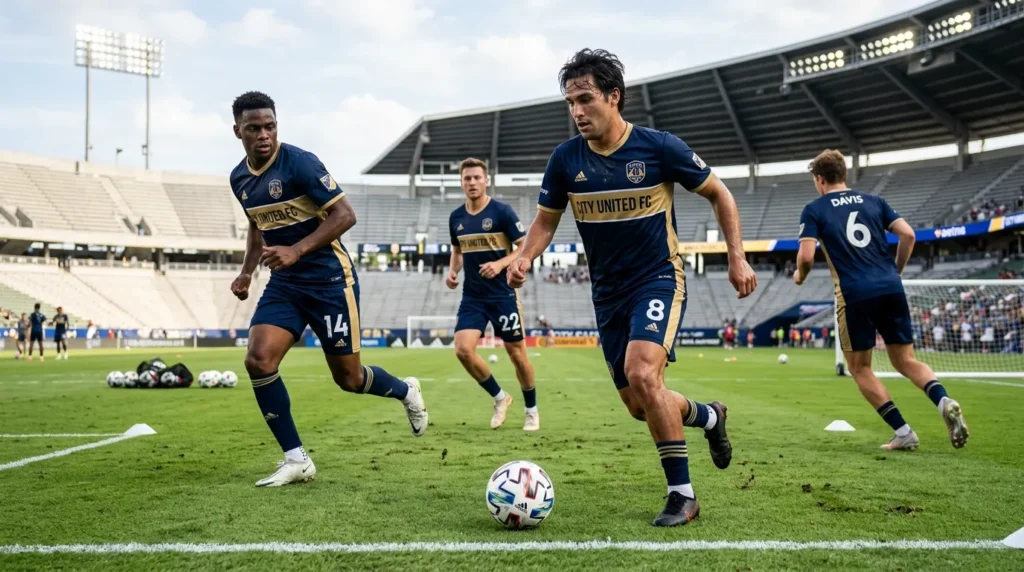
Sports Uniforms
Control points include:
- Player names
- Jersey numbers
- Sponsor logos
- Colour consistency
- Sublimation alignment
- Neck construction
- Sleeve finish
- Shorts sizing
- Size assortments
- Packing by team or player
Read the Custom Sports Uniforms Guide for full teamwear planning.
Hoodies and Tracksuits
Control points include:
- Fabric shade
- GSM
- Rib matching
- Zipper length
- Pocket symmetry
- Sleeve length
- Embroidery placement
- Top-and-bottom size matching
- Shrinkage
- Packing as complete sets
Yoga Wear and Leggings
Control points include:
- Stretch recovery
- Waistband measurement
- Seam stretch
- Opacity
- Panel symmetry
- Rise
- Inseam
- Silicone or print placement
- Measurement after relaxation
Equestrian Apparel
Control points include:
- Riding-position fit
- Waist stability
- Grip placement
- Leg-panel symmetry
- Stretch recovery
- Seat construction
- Competition branding
- Durability at contact points
Motorcycle Apparel
Control points include:
- Reinforcement placement
- Armour pocket dimensions
- Zipper security
- Riding-posture sleeve length
- Seam construction
- Reflective placement
- Lining alignment
- Protective component records
Performance or certification claims must be supported by applicable testing and documentation.
Bags and Accessories
Control points include:
- Dimensions
- Zippers
- Strap strength
- Handle reinforcement
- Lining
- Pocket placement
- Logo position
- Load-related seams
- Hardware
- Carton protection
Controlled Reorders Protect Brand Consistency
A successful first order is not enough.
The second production run should match the first approved version.
A reorder file should retain:
- Final tech pack
- Approved sample
- Pattern revision
- Measurement chart
- Fabric reference
- Fabric supplier and code
- Trim card
- Artwork
- Print settings
- Embroidery details
- Label files
- Packaging file
- QC findings
- Corrective-action history
- Buyer approvals
Without these records, a reorder may look and feel different despite carrying the same style code.
How GHC Sportswear® Approaches Controlled Manufacturing
GHC Sportswear® has operated since 2014 as a B2B custom sportswear, apparel and equestrian-gear manufacturer supporting international brands, teams, academies, retailers, wholesalers, distributors and private label businesses.
The manufacturing workflow can include:
- Buyer requirement review
- Product planning
- Fabric and trim direction
- Sample development
- Measurement and fit approval
- Pre-production confirmation
- Production-file release
- Material inspection
- Controlled cutting
- First-piece approval
- In-line quality checks
- End-line inspection
- Finishing and measurement control
- Packing verification
- Final inspection
- Reorder documentation
This approach supports consistency across:
- Sports uniforms
- Football kits
- Basketball uniforms
- Baseball uniforms
- Rugby uniforms
- Cricket uniforms
- Tracksuits
- Hoodies
- Jackets
- Polo shirts
- Activewear
- Compression clothing
- Yoga wear
- Men’s sportswear
- Women’s sportswear
- Equestrian apparel and gear
- Saddle pads
- Horse rugs
- Motorcycle apparel
- Bags
- Socks
- Private label collections
Explore the complete GHC Sportswear® product range and custom manufacturing services.
What GHC Sportswear® Does Not Overclaim
Controlled manufacturing should be demonstrated through specifications, samples, inspections and production records.
GHC Sportswear® does not treat the use of an ISO reference as proof that every product or facility is certified.
Where buyers require:
- Certified fabrics
- Independent laboratory tests
- Specific performance standards
- Restricted-substance documentation
- Inspection reports
- Compliance records
These requirements should be identified before costing, sampling and bulk production.
Information Buyers Should Send Before Production
For accurate planning and controlled manufacturing, send:
- Product category
- Reference images
- Tech pack
- Target quantity
- Intended market
- Fabric specification
- GSM requirement
- Colour reference
- Size range
- Measurement chart
- Print or embroidery files
- Trim requirements
- Label requirements
- Packaging instructions
- Test requirements
- Inspection requirements
- Delivery country
- Sample requirement
- Bulk deadline
- Reorder expectations
Example:
“Need 600 private label tracksuits in adult and youth sizes. Polyester-spandex scuba fabric, black and royal-blue panels, embroidered chest logo, YKK zipper preference, branded woven labels, individual polybags, pre-production sample and size-set approval required before bulk.”
Clear input supports controlled output.
Contact and Project Information
Brands can contact GHC Sportswear® for product planning, sampling, custom sportswear, private label apparel, sports uniforms, equestrian gear, motorbike apparel and controlled bulk production.
Send the product details through WhatsApp, email info@ghcsportswear.com, or submit the project through the GHC Sportswear® contact page.
Buyers may request:
- Product feasibility review
- Tech-pack review
- Fabric and trim discussion
- Physical sample development
- Branding-method consultation
- Bulk quotation
- Quality-control planning
- Repeat-order development
Follow GHC Sportswear®
Follow GHC Sportswear® for custom manufacturing, sampling, sportswear development, equestrian gear, motorbike apparel and B2B production updates.
GHC Sportswear® is available on TikTok, Threads, Instagram, the Instagram Channel, Pinterest, LinkedIn, YouTube, Facebook, Medium, Quora, X, Bluesky, and the WhatsApp Channel.
GHC Sportswear® is also listed on B2BMAP, Alibaba TrustPass, EC21, Blinx, and Wikidata.
Frequently Asked Questions
What is controlled manufacturing?
Controlled manufacturing is a structured production system that uses approved documents, standard procedures, trained operators, reliable measurements, quality checkpoints, traceability and corrective action to produce consistent output.
Is it proven that 70% of production issues start on the factory floor?
Not universally. The 70% figure should be treated as a factory diagnostic or improvement target. Each manufacturer should classify its defects and calculate the actual percentage caused by floor execution.
What causes garment production inconsistencies?
Common causes include outdated instructions, mixed fabric batches, inaccurate cutting, changing machine settings, operator variation, weak supervision, measurement drift, poor in-line inspection and packing errors.
What is first-piece approval?
First-piece approval is the inspection and authorization of the first production garments before the line continues at full volume. It confirms measurements, construction, trims, labels and workmanship.
What is first-pass yield?
First-pass yield is the percentage of units that pass inspection without repair or rework. It helps reveal the true stability of the manufacturing process.
What is DHU in garment manufacturing?
DHU means defects per hundred units. It is calculated by dividing the total defects found by the number of units inspected and multiplying by 100.
What is the difference between DHU and defective rate?
DHU counts every defect. Defective rate counts garments containing one or more defects. One garment can contain several defects.
Is final inspection enough to control apparel quality?
No. Final inspection can support a shipment decision, but it cannot prevent defects already created. Quality should be controlled during material receiving, cutting, sewing, finishing and packing.
What is AQL?
AQL is an acceptance-quality-limit framework used in sampling inspection. It supports acceptance or rejection decisions for production lots but does not guarantee zero defects.
Does passing AQL mean the production process was efficient?
Not necessarily. A shipment may pass final inspection after extensive internal rework. Buyers should also review first-pass yield, rework, defect trends and corrective actions.
Why is measurement control important?
Inaccurate tools or inconsistent measurement methods can produce incorrect acceptance decisions, sizing variation and customer complaints. Measurement points, methods, tolerances and equipment should be controlled.
How does supervisor training affect production?
Supervisors influence line balance, communication, quality response and operator performance. Better Work has reported measurable productivity improvements within its specific supervisory-training programme.
What is a corrective action?
Corrective action identifies and removes the root cause of a defect to prevent recurrence. Repairing the affected garment alone is not corrective action.
How does controlled manufacturing reduce cost?
It reduces rework, scrap, repair labour, late-stage inspection, production stoppages, replacement orders, shipment delays and customer returns.
What records should a manufacturer retain for reorders?
The manufacturer should retain the final tech pack, approved sample, measurement chart, fabric and trim references, pattern version, artwork, labels, packaging details, QC results and corrective-action history.
Can GHC Sportswear® support controlled bulk production?
Yes. GHC Sportswear® supports product planning, sampling, fabric and trim direction, custom sportswear, private label apparel, sports uniforms, equestrian gear, motorbike apparel, controlled bulk production, quality checks and reorder planning.
Final Thoughts
Controlled manufacturing is what turns an approved product into a consistent bulk order.
Good designs establish the product direction.
Good sourcing supplies the right materials.
Good sampling proves the product can be made.
Controlled manufacturing proves it can be made repeatedly.
The 70% figure should not be repeated as an unverified universal fact. It should challenge brands and manufacturers to measure where their defects actually begin.
When most problems originate on the floor, the solution is not more final inspection.
The solution is:
- Better production files
- Controlled materials
- Accurate cutting
- First-piece approval
- Standardized operations
- Reliable measurements
- Trained supervision
- In-line quality control
- Traceability
- Root-cause correction
- Measurable KPIs
GHC Sportswear® supports international buyers with apparel planning, sampling, sourcing, private label development, sportswear, uniforms, equestrian gear, motorbike apparel and controlled bulk manufacturing.
Reliable manufacturing is not the absence of problems.
It is the ability to identify, contain, correct and prevent them before they reach the customer.