Leather vs Synthetic Horse Tack: What Riders Prefer Today and What Buyers Should Choose
The debate around leather vs synthetic horse tack is not new, but rider preferences are changing.
Traditional riders still value leather for its feel, look, flexibility, repair potential, and long-term use. Riding schools, trail riders, beginners, and busy yards often prefer synthetic tack because it is lighter, easier to clean, more weather-resistant, and lower maintenance.
The real question is not:
“Is leather better than synthetic?”
The better question is:
“Which tack material suits the horse, rider, discipline, climate, maintenance routine, budget, and long-term use?”
Leather and synthetic tack can both work well when properly made, correctly fitted, and maintained. Both can also fail when quality is poor, fit is wrong, or the buyer chooses only by price.
For riding schools, academies, equestrian retailers, wholesalers, distributors, and private label brands, this decision becomes commercial. Material choice affects product lifespan, customer satisfaction, replacement rates, care instructions, bulk consistency, and brand trust.
GHC Sportswear® supports custom equestrian gear manufacturing, bulk equestrian gear manufacturing, leather and synthetic tack development, saddle pads, bridles, halters, horse rugs, riding apparel, private label equestrian products, and scalable production for B2B buyers worldwide.
Direct Answer: Leather vs Synthetic Horse Tack
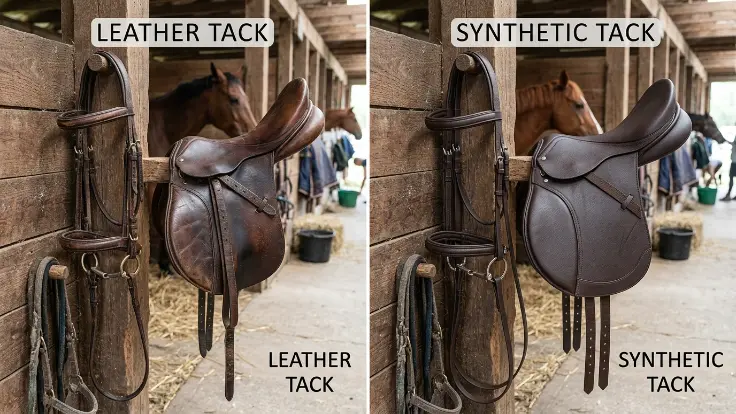
Leather vs synthetic horse tack comes down to feel, maintenance, durability, cost, weather resistance, and use case. Leather tack is traditional, flexible, premium-looking, repairable, and long-lasting when cared for properly. Synthetic tack is lightweight, easy to clean, weather-resistant, practical for daily use, and often more cost-efficient for riding schools or multi-horse operations.
| Factor | Leather Horse Tack | Synthetic Horse Tack |
|---|---|---|
| Material type | Natural animal hide | Engineered material, webbing, coated textile, synthetic leather, or technical polymer |
| Feel | Traditional, flexible, premium | Lightweight, stable, practical |
| Maintenance | Needs cleaning and conditioning | Usually easier to clean |
| Weather resistance | Sensitive to damp, heat, and dryness | Generally stronger for wet or muddy use |
| Lifespan | Long when quality and care are good | Depends on material grade and stress level |
| Comfort | Can soften and adapt over time | Consistent shape and easier care |
| Repairability | Often repairable by saddler | Depends on construction |
| Upfront cost | Usually higher | Usually lower to mid-range |
| Best for | Professional use, showing, premium tack, long-term ownership | Riding schools, wet climates, trail riding, beginners, high-rotation tack systems |
There is no single winner. Leather wins when feel, tradition, appearance, and repairability matter. Synthetic wins when convenience, weather use, lower maintenance, and bulk practicality matter.
Why Material Choice Matters
Tack is not decoration. It directly affects comfort, control, communication, and safety.
Poor material choice can cause:
- Rubbing
- Cracking
- Stretching
- Weak stitching
- Poor buckle support
- Heat buildup
- Slipping
- Stiffness
- Poor fit consistency
- Higher replacement cost
- Customer complaints
- Horse discomfort
The British Horse Society tack-fit guidance explains that correct tack fit is important for comfort and effective riding. The RSPCA horse gear guidance also identifies common areas affected by poor equipment fit, including the mouth corners, base of the ears, nose, jaw, girth area, and back.
Material cannot replace correct fit. A high-quality leather bridle can still hurt if it is too tight. A synthetic girth can still rub if the shape is wrong. A saddle pad can still slip if the saddle fit is poor.
The best tack decision combines material quality with proper fit.
Equestrian Market Context: Why Tack Decisions Matter
The horse riding equipment market is commercially important. Grand View Research valued the global horse riding equipment market at USD 1.6 billion in 2023 and projected it to reach USD 2.7 billion by 2030.
That growth is driven by riders, clubs, schools, retail buyers, online stores, private label brands, and equestrian businesses looking for reliable gear.
For B2B buyers, leather vs synthetic horse tack is not only a material debate. It is a product-line decision.
A brand may choose:
- Leather bridles for premium retail
- Synthetic halters for daily stable use
- Technical girths for easy cleaning
- Leather reins for grip and feel
- Synthetic rugs and webbing products for weather use
- Mixed product lines for different buyer levels
A smart equestrian brand does not force one material into every product. It chooses by use case.
Leather Horse Tack: What Riders Like
Leather has a strong place in equestrian culture because it feels traditional, premium, and familiar.
Riders often prefer leather for:
- Bridles
- Reins
- Saddles
- Breastplates
- Martingales
- Stirrup leathers
- Show tack
- Premium competition gear
- Long-term personal tack sets
Leather tack is valued because it can become more flexible with use, develops a classic appearance, and can often be repaired if the material is high quality.
Main advantages of leather tack
| Advantage | Why Riders Value It |
| Traditional feel | Familiar contact and classic riding appearance |
| Premium look | Strong for shows, retail, and competition presentation |
| Flexibility | Good leather can soften with use |
| Repair potential | Many leather items can be repaired by a saddler |
| Long lifespan | Can last years with correct care |
| Strong resale value | Quality leather often holds better value |
| Professional image | Favoured in many formal riding environments |
Leather is often preferred when the rider wants feel, appearance, and long-term ownership.
Leather Horse Tack: Weak Points
Leather is not perfect.
Leather tack can fail if it is not cared for properly. It can dry out, crack, stiffen, mould, stretch, or weaken around buckle holes and stitching areas.
Common leather problems include:
- Cracking from dryness
- Mould in damp tack rooms
- Stiffness from poor storage
- Sweat and salt damage
- Fading from sunlight
- Heavy maintenance needs
- Higher upfront price
- Inconsistent quality in cheap leather
- Sensitivity to climate
The Canadian Conservation Institute explains that heat and low humidity can dry leather, while damp conditions can support mould risk. Michigan State University Extension also advises that a clean, cool, relatively dry room is ideal for tack storage. Michigan State University Extension
For leather cracking prevention, read Why Leather Tack Cracks So Fast after the clean public URL is confirmed.
Synthetic Horse Tack: What Riders Like
Synthetic horse tack has grown because it solves many practical problems.
Riders often choose synthetic tack for:
- Riding schools
- Beginners
- Pony clubs
- Trail riding
- Wet climates
- Daily training
- Easy-clean stable equipment
- High-rotation tack systems
- Budget-conscious buyers
- Colourful product ranges
- Multi-horse yards
Synthetic tack is popular because it is usually lighter, easier to clean, and less sensitive to weather than leather.
Main advantages of synthetic tack
| Advantage | Why Riders Value It |
| Low maintenance | Easy cleaning for busy yards |
| Weather resistance | Better for rain, mud, and wet climates |
| Lightweight feel | Easier handling for beginners and children |
| Lower upfront cost | Useful for schools and bulk buyers |
| Colour variety | Good for branded or colour-coded tack systems |
| Consistency | Shape and finish can stay more predictable |
| Practical cleaning | Useful in high-use environments |
| Vegan-friendly option | Some buyers prefer non-leather products |
Synthetic tack is often preferred when convenience and daily practicality matter.
Synthetic Horse Tack: Weak Points
Synthetic tack also has limits.
Common problems include:
- Lower premium feel
- Less traditional appearance
- Limited repair options
- Heat sensitivity in some materials
- Webbing wear
- Coating damage
- Edge cracking in low-quality synthetic leather
- Possible stiffness in poor material
- Lower resale value in some categories
- Less acceptance in formal show environments
Synthetic does not mean automatically durable. Quality still depends on material specification, stitching, hardware, finishing, and design.
A low-grade synthetic bridle can fail faster than a good leather bridle. A high-quality technical synthetic product can outperform poor leather.
Leather vs Synthetic Horse Tack: Detailed Comparison
| Category | Leather Tack | Synthetic Tack | Buyer Note |
| Traditional appearance | Strong | Moderate | Leather often preferred for formal show look |
| Daily cleaning | More time required | Easier | Synthetic wins for riding schools |
| Weather use | Needs more care | Stronger | Synthetic better for wet conditions |
| Comfort feel | Can soften and adapt | Consistent | Depends on material quality |
| Repairability | Often better | Limited | Leather wins for long-term repair |
| Upfront cost | Higher | Lower to mid-range | Synthetic often easier for bulk buying |
| Long-term value | High with care | Good if quality is strong | Depends on use intensity |
| Weight | Heavier | Lighter | Synthetic easier for youth and schools |
| Colour options | Traditional tones | More colours possible | Synthetic useful for branding |
| Premium retail appeal | Strong | Product-dependent | Leather often stronger in luxury positioning |
| Maintenance training | Required | Simple | Synthetic easier for staff systems |
| Climate sensitivity | Higher | Lower | Synthetic better in harsh wet use |
Durability: Which Lasts Longer?
The honest answer: both can last when quality is good and use is appropriate.
Leather may last longer when:
- It is high-quality leather
- It is cleaned correctly
- It is conditioned properly
- It is stored in good conditions
- It is inspected regularly
- It is repaired early
- It is not exposed to extreme damp, heat, or dryness
Synthetic may last longer when:
- It is high-quality technical material
- It is used in wet or muddy environments
- It is cleaned frequently
- It is not overloaded beyond design
- It has strong stitching and hardware
- It is selected for the correct discipline
The UF/IFAS Extension saddle and tack care guide notes that tack contacts sweat, dirt, rain, and rider sweat, and that hidden areas such as stirrup leathers and rigging areas are often missed in care routines.
Durability comes from quality plus maintenance, not material name alone.
Maintenance: The Biggest Difference
Maintenance is one of the clearest differences between leather and synthetic tack.
| Maintenance Area | Leather Tack | Synthetic Tack |
| Wipe after use | Recommended | Recommended |
| Deep cleaning | Needed | Needed but usually simpler |
| Conditioning | Required when leather dries | Not required |
| Mould prevention | Important | Less sensitive but still needs clean storage |
| Storage | Cool, dry, ventilated | Less strict but still important |
| Sun and heat risk | Higher | Material-dependent |
| Wet climate care | More demanding | Easier |
| Staff training | More detailed | Simpler |
| Time required | Higher | Lower |
For leather tack care, Michigan State University Extension recommends keeping tack clean, cool, and relatively dry, while BHS highlights regular cleaning and proper storage for tack longevity. BHS saddle and tack care
Cost vs Long-Term Value
Leather usually costs more upfront. Synthetic often costs less upfront.
But value depends on lifespan, use, and maintenance.
| Buying Scenario | Leather Value | Synthetic Value |
| Professional rider with one main horse | Strong | Good backup option |
| Riding school with many horses | Good but care-heavy | Strong practical value |
| Wet climate trail riding | Requires careful maintenance | Strong |
| Premium show tack | Strong | Limited depending on rules/style |
| Beginner starter tack | Higher cost | Practical |
| Retail private label line | Premium positioning | Accessible product range |
| Bulk stable equipment | Higher investment | Easier cost control |
| Long-term repairable tack | Strong | Depends on construction |
A cheap product in either material can become expensive. For cost planning, read Cheap Tack vs Quality Tack.
Cost Model: Leather vs Synthetic Horse Tack
Exact prices vary by country, quality, supplier, hardware, and product type. This is a practical comparison model, not a fixed price list.
| Product Type | Leather Tack Typical Cost Position | Synthetic Tack Typical Cost Position | Main Cost Risk |
| Bridle | Medium to high | Low to medium | Fit, material softness, stitching |
| Halter | Medium | Low to medium | Hardware and webbing strength |
| Reins | Medium to high | Low to medium | Grip and stretching |
| Breastplate | Medium to high | Medium | Stress-point strength |
| Girth | Medium to high | Medium | Rubbing, elastic, shape |
| Saddle pad | Usually textile, not leather | Technical textile | Quilting, lining, slip control |
| Horse rug | Textile/synthetic | Technical textile | Fabric strength and waterproofing |
| Stable set | Higher care cost | Easier rotation | Replacement frequency |
The best financial decision is not always the cheapest one. It is the item that performs safely, lasts long enough, and fits the intended use.
What Riders Prefer Today
Modern rider preference is becoming more practical and less traditional-only.
Many riders now choose by category:
| Rider Type | Likely Preference | Reason |
| Professional competitor | Leather | Feel, appearance, tradition |
| Riding school | Synthetic or mixed | Easy care and replacement control |
| Trail rider | Synthetic or mixed | Weather resistance and practicality |
| Pony club family | Synthetic | Lightweight and easy cleaning |
| Show rider | Leather | Formal presentation |
| Busy amateur rider | Mixed | Leather for main tack, synthetic for daily use |
| Retail buyer | Both | Different price points |
| Private label brand | Both | Wider product range |
| Distributor | Mixed | Category-based demand |
The market is not moving from leather to synthetic completely. It is moving toward use-case-based buying.
Use-Case Winner Table
| Use Case | Better Choice |
| Formal show bridle | Leather |
| Wet-weather trail riding | Synthetic |
| Riding-school daily halters | Synthetic |
| Premium retail tack line | Leather |
| Easy-clean beginner gear | Synthetic |
| Long-term repairable tack | Leather |
| Colour-coded stable system | Synthetic |
| Traditional riding appearance | Leather |
| High-volume school use | Synthetic or mixed |
| Private label product range | Leather + synthetic |
A complete equestrian brand can offer both materials instead of forcing one winner.
Comfort and Fit: Material Alone Is Not Enough
Riders often ask whether leather or synthetic is more comfortable.
The real answer: comfort depends on fit, softness, shape, padding, adjustability, and construction.
A good bridle needs:
- Correct browband length
- Correct cheekpiece adjustment
- Noseband comfort
- Soft edges
- Good buckle placement
- Correct bit position
- No pinching behind ears
- Good strap balance
A good girth needs:
- Correct shape
- Smooth contact
- Strong elastic
- No rubbing behind elbows
- Suitable width
- Secure buckle alignment
A good saddle pad needs:
- Correct size
- Stable quilting
- Breathable lining
- Proper shape
- Suitable thickness
- No bunching
- Good wash performance
For related fit issues, read Bridle Doesn’t Fit? Common Bridle Fitting Mistakes Riders Should Fix and Why Saddle Keeps Slipping.
Leather Tack: Best Product Categories
Leather is often suitable for:
- Bridles
- Reins
- Breastplates
- Martingales
- Stirrup leathers
- Premium halters
- Show tack
- Traditional competition gear
- Premium private label collections
Leather works best when the buyer values:
- Premium appearance
- Rider feel
- Long-term repair
- Traditional styling
- Retail positioning
- Show presentation
Synthetic Tack: Best Product Categories
Synthetic materials are often suitable for:
- Halters
- Lead ropes
- Training bridles
- Daily-use reins
- Webbing products
- Rain-friendly tack
- Riding-school equipment
- Youth equipment
- Colour-coded tack systems
- Stable accessories
- Rug components
- Easy-clean product lines
Synthetic works best when the buyer values:
- Easy cleaning
- Lower maintenance
- Water resistance
- Lower upfront cost
- Lightweight handling
- Daily durability
- Colour variety
- Bulk practicality
B2B Buyer Perspective: Why Material Choice Affects Supply Chain
For B2B buyers, leather vs synthetic horse tack affects the full supply chain.
It influences:
- Unit price
- Minimum order quantity
- Sample cost
- Production time
- Hardware selection
- Stitching method
- Packaging
- Care labels
- Quality control
- Returns
- Customer education
- Reorder planning
- Brand positioning
A private label brand may build a premium leather range and an accessible synthetic range. A riding school supplier may focus on synthetic halters and easy-clean bridles. A retailer may stock both to serve different customers.
Bulk Buying Comparison
| Bulk Requirement | Leather Tack | Synthetic Tack |
| Premium positioning | Strong | Moderate |
| Easy staff cleaning | More difficult | Strong |
| Wet climate practicality | Requires care | Strong |
| Colour-coded programs | Limited | Strong |
| Repairable long-term product | Strong | Depends |
| Lower entry price | Weaker | Strong |
| Riding-school rotation | Care-heavy | Strong |
| Show collection | Strong | Limited |
| Private label range | Strong | Strong |
| Customer education | Care instructions needed | Simpler care guidance |
For bulk buyers, the best strategy is often a mixed product range.
Quality Control Checklist for Leather Tack
Before approving leather tack production, check:
- Leather grade
- Thickness consistency
- Flexibility
- Surface finish
- Edge finishing
- Stitching quality
- Buckle strength
- Hole punching quality
- Padding softness
- Strap alignment
- Colour consistency
- Smell and chemical finish
- Pull strength where relevant
- Packaging ventilation
- Care label clarity
- Sample approval
Quality Control Checklist for Synthetic Tack
Before approving synthetic tack production, check:
- Material type
- Webbing strength
- Coating durability
- Stitching strength
- Heat resistance where relevant
- Water resistance
- Edge finishing
- Hardware strength
- Buckle security
- Colour consistency
- Cleaning method
- Flexibility
- Abrasion resistance
- Label instructions
- Sample approval
The material may be different, but the quality-control discipline should be equally strict.
Leather vs Synthetic Horse Tack: Common Mistakes
Avoid these mistakes:
- Choosing only by price
- Assuming all leather is high quality
- Assuming all synthetic is low quality
- Ignoring fit
- Ignoring hardware strength
- Ignoring stitching
- Skipping sample approval
- Using leather in wet use without care planning
- Using cheap synthetic in high-stress areas
- Not providing care instructions
- Ordering bulk without testing
- Selling premium tack without material transparency
- Forgetting climate and use case
- Not planning reorders
The best material choice is practical, not emotional.
Maintenance Routine for Leather Tack
For leather tack:
- Wipe sweat and dirt after use.
- Clean with tack-safe products.
- Condition when leather feels dry.
- Store in a clean, dry, ventilated tack room.
- Avoid direct sunlight and strong heat.
- Inspect buckle holes and stitching.
- Do not over-oil.
- Keep wet saddle pads away from leather.
- Repair small issues early.
- Replace unsafe cracked tack.
For leather cracking prevention, read Why Leather Tack Cracks So Fast after the article is publicly live.
Maintenance Routine for Synthetic Tack
For synthetic tack:
- Wipe dirt and sweat after use.
- Clean according to material instructions.
- Avoid harsh chemicals unless approved.
- Check webbing edges.
- Check buckles and stitching.
- Inspect coating damage.
- Store clean and dry.
- Avoid extreme heat if material is sensitive.
- Replace worn or cracked coated parts.
- Keep care labels clear for customers.
Synthetic is easier to maintain, but it is not maintenance-free.
Buying Guide: Which One Should You Choose?
Choose leather tack if:
- You want a traditional look
- You value riding feel
- You need premium presentation
- You can maintain it properly
- You want repair potential
- You are buying show tack
- You want long-term ownership
- Your climate and storage conditions are suitable
Choose synthetic tack if:
- You want low maintenance
- You ride in wet or muddy conditions
- You manage many horses
- You run a riding school
- You want lightweight tack
- You need colour-coded systems
- You want easier cleaning
- You need budget-friendly bulk equipment
Choose both if:
- You are building a retail product line
- You serve different rider levels
- You supply schools and private riders
- You want premium and entry-level options
- You need practical and show categories
- You want wider market coverage
Product Line Strategy for Equestrian Brands
A strong equestrian brand can divide products by buyer type.
| Product Line | Material Direction | Target Buyer |
| Premium show tack | Leather | Competitors and premium retail |
| Daily training tack | Synthetic or mixed | Busy riders and schools |
| Youth equipment | Synthetic | Pony clubs and beginners |
| Trail riding gear | Synthetic | Outdoor riders |
| Retail starter range | Synthetic | Entry-level buyers |
| Heritage collection | Leather | Traditional riders |
| Riding-school supply | Synthetic and technical textiles | Academies and clubs |
| Private label luxury range | Leather | Premium equestrian brands |
This approach creates product variety without confusing customers.
Product Categories Supported by GHC Sportswear®
GHC Sportswear® supports custom equestrian products for riders, clubs, academies, retailers, wholesalers, distributors, and private label brands.
Supported categories include:
- Bridles
- Halters
- Lead ropes
- Martingales
- Breastplates
- Saddle pads
- Ear bonnets
- Fly masks
- Horse rugs
- Stable rugs
- Turnout rugs
- Cooler rugs
- Saddle covers
- Equestrian bags
- Riding jackets
- Show jackets
- Breeches
- Jodhpurs
- Riding leggings
- Base layers
- Competition shirts
- Polo shirts
- Gilets
- Hoodies
- Gloves
- Private label equestrian apparel
- Club and academy equestrian gear
Customization options include:
- Leather or synthetic material direction
- Technical fabric selection
- Webbing and hardware selection
- Stitching colour
- Quilting patterns
- Embroidery
- Sublimation
- Heat transfer
- Woven labels
- Rubber badges
- Colour matching
- Private label packaging
- Sample development
- Bulk production
- Reorder planning
Explore GHC Sportswear® products, GHC Sportswear® services, custom equestrian gear manufacturing, and equestrian gear manufacturing.
What to Send for Leather or Synthetic Tack Production
For accurate product development, send:
- Product category
- Quantity
- Leather, synthetic, or mixed material preference
- Material thickness target
- Hardware preference
- Colour requirement
- Size range
- Stitching colour
- Padding requirement
- Logo file
- Branding method
- Packaging requirement
- Care label requirement
- Reference photos
- Target market
- Everyday, school, trail, or competition use
- Delivery country
- Sample requirement
- Reorder plan
Example:
“Need 200 private label halters and 100 matching bridles for riding school and retail use. Synthetic easy-clean material for halters, leather option for premium bridles, black and navy colourways, strong hardware, branded packaging, delivery to UK, sample required before bulk.”
Clear details help reduce sampling errors and improve bulk consistency.
Contact and Project Information
For leather or synthetic horse tack, custom equestrian gear, saddle pads, bridles, halters, horse rugs, riding apparel, wholesale equestrian products, or private label equestrian collections, buyers can contact GHC Sportswear® with product details, reference photos, quantity, and target deadline.
Contact GHC Sportswear® through WhatsApp, email info@ghcsportswear.com, or the GHC Sportswear® contact page.
GHC Sportswear® Official Profiles and Business Links
Buyers can connect with GHC Sportswear® through the official website, social media channels, community platforms, directory listings, and B2B trade profiles.
Visit the GHC Sportswear® official website for custom sportswear, team uniforms, equestrian gear, motorbike gear, yoga wear, and private label manufacturing.
Follow GHC Sportswear® on TikTok, Threads, Instagram, Instagram Channel, Pinterest, LinkedIn, YouTube, Facebook, Medium, Quora, X, Bluesky, and the WhatsApp Channel.
GHC Sportswear® is also listed on B2BMAP, Alibaba TrustPass, EC21, Blinx, and Wikidata.
FAQ: Leather vs Synthetic Horse Tack
Which is better, leather or synthetic horse tack?
Neither is automatically better. Leather is often preferred for traditional feel, premium appearance, repairability, and long-term ownership. Synthetic tack is often preferred for low maintenance, weather resistance, lightweight handling, and riding-school practicality.
Does leather tack last longer than synthetic tack?
High-quality leather tack can last many years with correct care, cleaning, conditioning, and storage. High-quality synthetic tack can also last well, especially in wet or high-use environments. Poor-quality versions of either material can fail quickly.
Is synthetic horse tack good for beginners?
Yes, synthetic tack can be useful for beginners because it is usually lighter, easier to clean, and often more affordable. Fit and safety still matter.
Is leather tack better for showing?
Leather tack is often preferred for traditional show presentation, premium appearance, and formal riding environments. Exact requirements depend on discipline, event rules, and rider preference.
Is synthetic tack waterproof?
Many synthetic tack products are more water-resistant than leather, but not every synthetic material is fully waterproof. Buyers should check material specifications and care instructions.
Does synthetic tack need maintenance?
Yes. Synthetic tack usually needs less maintenance than leather, but it still needs cleaning, inspection, proper storage, and hardware checks.
Why do riding schools often choose synthetic tack?
Riding schools often choose synthetic tack because it is easy to clean, lightweight, practical for many riders, more weather-resistant, and easier to manage across multiple horses.
Can leather tack crack?
Yes. Leather tack can crack when it dries out, is exposed to sweat and salt, is stored badly, receives poor care, or is made from low-quality leather.
What should B2B buyers choose for bulk equestrian gear?
B2B buyers should choose based on target customer, product category, climate, maintenance expectation, price point, and brand positioning. Many successful product lines use both leather and synthetic options.
Can GHC Sportswear® manufacture leather and synthetic equestrian gear?
Yes. GHC Sportswear® supports custom equestrian gear, leather or synthetic material direction, bridles, halters, saddle pads, horse rugs, riding apparel, private label packaging, sample development, bulk production, and international delivery coordination.
Conclusion
The leather vs synthetic horse tack decision depends on how the tack will be used.
Leather offers tradition, feel, premium presentation, repair potential, and long-term value when maintained correctly. Synthetic tack offers lower maintenance, easier cleaning, lighter handling, weather resistance, and practical value for riding schools, trail riders, beginners, and high-use yards.
For riders, the best choice is the one that fits the horse, rider, discipline, climate, and care routine.
For riding schools, the best choice is often practical, easy-clean, and repeatable.
For retailers, the best choice may be a mixed product range.
For private label brands, the best choice is controlled material selection, sample testing, and clear product positioning.
For B2B buyers, the best choice is not leather or synthetic alone. It is consistent manufacturing quality.
GHC Sportswear® supports custom equestrian gear, leather and synthetic tack direction, saddle pads, bridles, halters, horse rugs, riding apparel, private label products, sample development, bulk manufacturing, and global delivery coordination.
Leather gives tradition and feel.
Synthetic gives convenience and practicality.
Quality production is what makes either option worth buying.