Bizarre Sports: 10 Strange Games and Their Wildest Rules
The world of sport is much bigger than football, basketball, cricket, rugby, tennis, and athletics. Around the world, people compete in games that look strange, painful, funny, chaotic, or almost impossible to explain to someone watching for the first time.
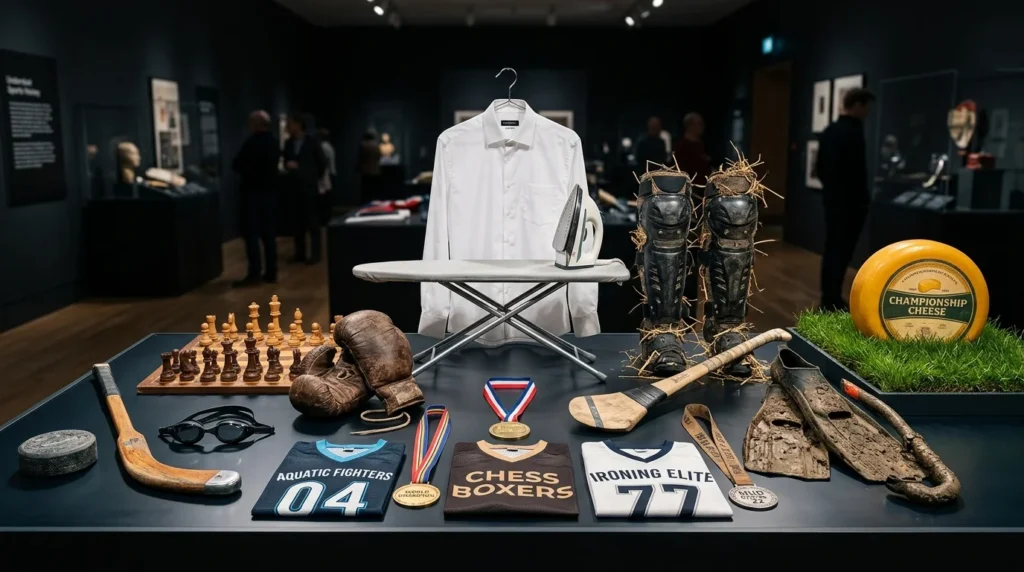
These bizarre sports prove that competition does not always need a stadium, a professional league, or a global television audience. Sometimes, all it needs is a swimming pool, a chessboard, a boxing ring, a hill, a bog, a broomstick, or, in one especially questionable case, a pair of trousers and a live ferret.
At first glance, many bizarre sports look like jokes. But when you study them properly, they often have real rules, traditions, dedicated communities, and surprisingly serious competitors. Underwater hockey demands lung capacity and teamwork. Chess boxing requires mental focus and physical toughness. Bog snorkelling has official rules about how athletes can move through muddy water. Shin kicking has safety rules, even if the sport itself still sounds like something invented by angry medieval cousins.
That is what makes bizarre sports useful for sports culture content. They show that sport is not only about winning trophies. Sport is also about identity, storytelling, local tradition, teamwork, courage, and sometimes complete madness.
For teams, clubs, academies, and sports brands, this matters. A sport becomes memorable when it has a clear identity. A team becomes memorable when its uniforms, colors, and culture are consistent. If you are building a serious teamwear system, GHC Sportswear® has a full Custom Sports Uniforms Guide covering fabrics, fit, printing, sizing, branding, and bulk uniform planning.
Why Bizarre Sports Become Popular
Bizarre sports become popular because they are easy to remember. Nobody forgets the first time they hear about cheese rolling, wife carrying, underwater hockey, or chess boxing. The idea itself becomes a hook.
Mainstream sports usually become famous through organized leagues, professional athletes, broadcast deals, and long traditions. Bizarre sports often spread differently. They become popular through festivals, local traditions, viral videos, charity events, unusual world records, and people saying, “You have to see this.”
That shareability is powerful.
Bizarre sports usually have at least one of these features:
- a strange playing environment
- a funny or painful rule
- an unusual combination of skills
- a local cultural tradition
- a high risk of chaos
- a strong visual identity
- simple rules that look absurd from the outside
This is also why these sports are good for brand storytelling. When something looks different, people talk about it. The same principle applies to sports uniforms and teamwear. Strong colors, clean logos, clear numbers, and memorable design help teams stand out.
Quick Comparison: What Makes These Bizarre Sports So Different?
| Sport | Main Setting | Weirdest Rule or Feature | Main Skill Needed |
|---|---|---|---|
| Underwater hockey | Swimming pool floor | Players hold breath while pushing puck underwater | Stamina and teamwork |
| Chess boxing | Ring and chessboard | Win by knockout or checkmate | Fight skill and strategy |
| Extreme ironing | Mountains, rivers, skydives, unusual locations | Clothes must still be ironed properly | Balance and absurd commitment |
| Shin kicking | Cotswold games field | Kicking shins is the point | Pain tolerance |
| Quadball | Field game inspired by fantasy sport | Seekers chase a flag runner | Team tactics and speed |
| Wife carrying | Obstacle course | Partner must meet weight rules in world events | Strength and balance |
| Toe wrestling | Foot-to-foot contest | Shoes and socks are not part of the fun | Toe strength |
| Bog snorkelling | Peat bog trench | Normal swimming strokes are banned | Flipper power |
| Cheese rolling | Steep hill | Getting down safely is optional in practice | Courage and gravity management |
| Ferret legging | Endurance stunt | Ferrets go inside secured trousers | Questionable bravery |
1. Underwater Hockey: Hockey Without Breathing Normally
Underwater hockey, also known as Octopush, is one of the strangest sports that becomes more impressive the more you understand it.
The game is played at the bottom of a swimming pool. Players wear fins, masks, snorkels, and protective gear. They use short sticks to move a puck across the pool floor and into the opponent’s goal area. The basic objective sounds familiar: move the puck and score. The strange part is that the entire game happens underwater.
CMAS, the international underwater sports federation, explains that underwater hockey is played by manoeuvring a puck across the bottom of the pool into the opposing team’s goal using a stick.
The wild rule is simple: players do not use scuba equipment while actively playing. They dive, hold their breath, fight for position, move the puck, then return to the surface for air. That creates a strange rhythm. A player might make a strong move, run out of breath, surface, and immediately be replaced by a teammate diving into the play.
Why Underwater Hockey Is Hard
- players must hold their breath
- vision is limited underwater
- communication is difficult
- puck control happens on the pool floor
- teamwork depends on timing and rotation
- stamina matters as much as skill
Underwater hockey looks strange, but it is a serious sport. It combines swimming, breath control, strength, tactics, and team coordination. It also proves that not every hockey game needs ice, turf, or skates.
2. Chess Boxing: The Sport That Punches Your Brain First
Chess boxing sounds like two completely different hobbies got into an argument and decided to share a room.
The sport combines chess and boxing in alternating rounds. Competitors may win by knockout, checkmate, resignation, time penalty, or decision depending on the format. That means a fighter has to survive punches and then sit down calmly enough to calculate chess moves.
World Chess describes chess boxing as a hybrid sport where competitors alternate between chess and boxing until one wins by checkmate or knockout. That combination is what makes the sport so unusual.
The hardest part may not be either discipline alone. It is the transition. Imagine throwing punches, taking hits, breathing heavily, then immediately needing to analyze a chess position. A tired boxer may blunder. A smart chess player may get knocked down before their strategy matters.
Chess Boxing Skills
| Boxing Side | Chess Side |
| footwork | calculation |
| defense | memory |
| punching power | pattern recognition |
| stamina | patience |
| pain tolerance | time management |
Chess boxing is not just a gimmick. It rewards athletes who can control adrenaline. A boxer who panics at the chessboard loses. A chess player who cannot defend in the ring loses. That balance is what makes the sport fascinating.
3. Extreme Ironing: The Sport That Makes Laundry Dangerous
Extreme ironing may be the only sport where someone can say, “I pressed a shirt on a mountain,” and mean it seriously.
The idea is simple: take an ironing board to a strange or extreme location and iron clothing. People have done it on cliffs, underwater, while skiing, while climbing, and in other absurd settings. It is usually described with a mix of humor, adventure, and performance art.
The wild rule is that the ironing still matters. It is not enough to stand somewhere dangerous with a board. The activity requires the person to actually press clothing. That is what makes it so funny. The sport combines the thrill of outdoor danger with the most ordinary household chore imaginable.
Why Extreme Ironing Works as Sports Culture
Extreme ironing works because it has a strong visual hook. People immediately understand the contrast:
- boring chore
- dangerous location
- serious commitment
- ridiculous image
- memorable story
It may not be a mainstream competitive sport, but it shows how far people will go to turn ordinary tasks into sport-like challenges.
There is also a strange lesson here for apparel brands. Presentation matters. Even in a joke sport, the final look of the clothing is still part of the point.
4. Shin Kicking: The Painful British Tradition
Shin kicking is exactly what it sounds like. Competitors hold each other and kick each other’s shins until one is forced down.
This brutal tradition is associated with the Cotswold Olimpick Games in England. The official shin kicking guidance says competitors wear long trousers or tracksuits, may cushion their shins with straw provided by organisers, and cannot use metal-reinforced footwear.
So yes, there are rules. But the rules mostly confirm that people are still intentionally kicking each other in the legs.
What Makes Shin Kicking So Strange?
| Normal Combat Sport | Shin Kicking |
| Punching or grappling | Kicking shins |
| Protective gloves | Straw in trousers |
| Full-body strategy | Pain focused on lower legs |
| Refined technique | Endurance and awkward balance |
The sport is painful, but it is also deeply tied to local tradition. That makes it more than random violence. It is a historical community event with rules, spectators, and a strange kind of pride.
Still, if your coach ever says shin kicking is part of training, ask for a second opinion.
5. Quadball: A Fictional Game That Became a Real Sport
Many people still know it by its original fantasy-inspired name, Quidditch, but the real-world sport is now widely called quadball by major organizations.
Quadball is played by teams with multiple ball types, role-specific players, and a flag runner. The International Quadball Association explains that seekers try to catch a flag attached to a neutral flag runner, and the catch is worth points. U.S. Quadball also explains that seekers chase the flag runner, with timing and point-cap rules affecting when the game ends.
The strangest part is that players run with a stick between their legs, preserving the visual idea from the fictional version. To new viewers, it looks chaotic. To players, it is a tactical mixed-gender team sport with passing, defending, tackling, scoring, and flag chasing.
Why Quadball Is More Serious Than It Looks
- it requires speed
- it uses multiple positions
- it involves physical contact
- it has tactical scoring
- it includes a separate seeker role
- it has a strong community culture
Quadball is a perfect example of how fictional sports can become real when fans organize rules, leagues, uniforms, and competitions.
For teams building identity in newer or niche sports, uniforms matter even more. A clear kit helps spectators understand teams and gives players a stronger sense of belonging. GHC Sportswear® supports teams and clubs through custom wholesale sports uniforms manufacturing.
6. Wife Carrying: A Race With Strength, Balance, and Strange Rules
Wife carrying is a Finnish-origin sport where a competitor carries a partner through an obstacle course. Despite the name, the carried person does not always need to be the carrier’s actual wife in many competitions.
One of the most famous rules from world-style wife carrying events is that the carried person must weigh at least 49 kg. If they weigh less, extra weight may be added. Some events also specify allowed equipment and safety requirements.
The sport looks funny, but it is physically demanding. The carrier needs strength, grip, balance, speed, and obstacle-course awareness. The carried partner also matters because positioning affects stability.
Common Carrying Styles
| Carrying Style | What It Looks Like | Main Challenge |
| Piggyback | Partner rides on back | Easy to understand but unstable at speed |
| Fireman’s carry | Partner across shoulders | Strong but awkward |
| Estonian carry | Partner upside down on back | Famous competition style |
| Front carry | Partner held in front | Heavy on arms |
Wife carrying is strange, but it is also a good example of sport as festival culture. It is competitive, funny, physical, and easy for crowds to enjoy.
7. Toe Wrestling: Arm Wrestling’s Foot-Based Cousin
Toe wrestling is like arm wrestling, except competitors lock toes and try to pin each other’s foot.
It is one of those sports that sounds fake until you realize people have actually competed in it. The sport is often associated with British pub and festival culture, and it has been covered widely as one of the world’s strangest competitions.
The rules usually involve bare feet, toe locking, and attempts to force the opponent’s foot down. Hygiene and nail checks are often discussed because, honestly, nobody wants an illegal toenail advantage.
Why Toe Wrestling Is Weirdly Competitive
- grip matters
- toe strength matters
- foot positioning matters
- pain tolerance matters
- balance matters
- crowd reaction matters
Toe wrestling proves that almost anything can become a sport if enough people agree on rules and show up to compete.
It also proves that not every athlete needs a full uniform. Sometimes, apparently, all you need is confidence and toes.
8. Bog Snorkelling: Swimming Through Mud Without Swimming Properly
Bog snorkelling is one of the dirtiest bizarre sports in the world.
The World Bog Snorkelling Championships are held in Wales, where competitors race through a trench cut in a peat bog. They wear snorkels and flippers and attempt to complete the course as fast as possible.
Green Events’ official bog snorkelling rules state that no recognized swimming stroke is allowed other than doggy paddle with hands and arms kept below the waterline. Many competitors rely mainly on leg propulsion.
That rule makes the sport much harder. In normal swimming, arms do a lot of work. In bog snorkelling, competitors must rely heavily on flippers and leg movement through thick, muddy water.
Bog Snorkelling vs Normal Swimming
| Normal Swimming | Bog Snorkelling |
| Clear pool water | Muddy peat water |
| Recognized strokes | Standard strokes banned |
| Lane visibility | Low visibility |
| Smooth movement | Thick water resistance |
| Pool environment | Outdoor bog trench |
Bog snorkelling is strange, messy, and surprisingly serious. It attracts competitors who enjoy endurance, novelty, and the kind of challenge that ruins clothing instantly.
9. Cheese Rolling: Chasing Dairy Down a Hill
Cheese rolling is one of the most famous bizarre sports in the world. At Cooper’s Hill in Gloucestershire, England, competitors chase a wheel of Double Gloucester cheese down a dangerously steep hill. Most do not run down gracefully. They tumble, roll, slide, fall, and hope gravity is feeling generous.
The basic idea is simple: get down the hill and cross the finish line. The cheese is released first, and competitors chase it. In practice, catching the cheese is almost impossible because it rolls very fast. The real race is usually between humans trying to reach the bottom.
Cheese rolling remains popular because it is simple, dangerous-looking, and visually unforgettable. It is also deeply connected to local tradition.
Why Cheese Rolling Is So Watchable
- the rule is easy to understand
- the hill is clearly dangerous
- the falls are dramatic
- the prize is funny
- the tradition is old
- the visuals are viral
Cheese rolling is proof that sports do not need complicated scoring systems to attract attention. Sometimes, the entire concept can be explained in one sentence: people chase cheese down a hill.
10. Ferret Legging: The Endurance Sport Nobody Asked For
Ferret legging is one of the strangest and most uncomfortable endurance contests ever described.
The basic idea is that participants place live ferrets inside their trousers and see who can endure the longest. The trousers are secured so the ferrets cannot escape. The sport is historically associated with parts of British working-class and pub culture, especially in older accounts.
This is not a mainstream sport, and modern animal welfare expectations make it controversial. Ferrets are living animals, not equipment, so this activity is often discussed more as bizarre folklore than something most people would encourage today.
Still, it remains part of lists about bizarre sports because it is almost impossible to forget once you hear about it.
Why Ferret Legging Is So Infamous
- it sounds unbelievable
- it involves endurance and pain tolerance
- it uses live animals
- it has strong shock value
- it feels more like a dare than a sport
Unlike underwater hockey or quadball, ferret legging is not a sport most modern brands would want to sponsor. But as a strange sports-history topic, it shows how far human competition can drift into absurdity.
For more strange but real sports stories, readers can also explore GHC Sportswear® articles like Unusual Sports Records, Sports Invented by Accident, and Quirky Sports Rules.
What Bizarre Sports Teach Us About Rules
The most interesting thing about bizarre sports is that they still need rules. Without rules, they are just chaos.
Rules make strange activities competitive. They define:
- who wins
- what is allowed
- what is banned
- how safety is managed
- how teams or players interact
- how spectators understand the contest
This is true for both strange sports and mainstream sports. Football, rugby, basketball, cricket, and cycling all rely on rules to create fair competition. Even unusual sports like bog snorkelling and wife carrying need clear boundaries.
That is why uniform rules also matter. In organized team sports, colors, numbers, sponsor logos, and kit consistency help officials, players, and fans understand the game. Teams planning serious kits should think about design and compliance early, not after production begins.
Bizarre Sports and Team Identity
Bizarre sports often have strong visual identity because the activity itself is memorable. Quadball players with sticks, underwater hockey players in pool gear, cheese rolling competitors flying down a hill, and bog snorkellers in flippers all create instant images.
Mainstream teams can learn from this. A team does not need a strange sport to become recognizable. It needs a strong identity system.
That includes:
- team colors
- logo placement
- jersey numbers
- sponsor visibility
- consistent fabric
- clean fit
- sport-specific design
- reliable reorders
If teams, academies, or clubs want uniforms that support identity and performance, they can explore the GHC Sportswear® product range for available sportswear and uniform categories.
Need Custom Sports Uniforms for Your Team, Club, or Brand?
GHC Sportswear® works with teams, clubs, academies, schools, wholesalers, distributors, sportswear brands, event organizers, and private label businesses that need custom sports uniforms and bulk apparel production.
We support:
- football uniforms
- rugby uniforms
- basketball jerseys
- cricket uniforms
- baseball uniforms
- cycling kits
- rowing uniforms
- volleyball uniforms
- training kits
- warm-up apparel
- team merchandise
- sponsor branding
- names and numbers
- sublimation and printing
- bulk teamwear production
- private label sportswear
If your team, club, academy, or brand needs custom uniforms that support identity, comfort, and repeat production, GHC Sportswear® can help with fabric selection, design support, sampling, branding, printing, packaging, and bulk manufacturing.
WhatsApp: https://wa.me/ghcsportswear
Email: info@ghcsportswar.com
Final Thoughts
Bizarre sports prove that human competition is endlessly creative. Some sports are strange because of where they are played. Some are strange because of what athletes wear. Some are strange because of the rules. Some are strange because nobody can explain why people agreed to do them in the first place.
Underwater hockey turns a swimming pool into a battlefield. Chess boxing turns mental focus into a combat skill. Extreme ironing turns laundry into adventure. Shin kicking turns pain into tradition. Quadball turns fiction into sport. Wife carrying turns partnership into an obstacle race. Toe wrestling turns feet into competition. Bog snorkelling turns muddy water into a racecourse. Cheese rolling turns a hill and a wheel of cheese into global spectacle. Ferret legging turns endurance into something most people would wisely avoid.
The lesson is simple: sport is not only about normal competition. It is about rules, identity, culture, courage, and stories people remember.
For teams and brands, that same lesson matters. The most memorable sports moments often come from strong identity. Whether the sport is mainstream or bizarre, the right gear helps people look organized, feel connected, and represent something bigger than themselves.